

Technology in the service industry moves in one direction: toward less friction. Every real shift in how businesses handle appointments, from paper calendars to phone systems to basic digital schedulers, has followed the same logic. Make it easier for clients to book. Make it easier for providers to manage. Remove as many points of failure in between as possible.
We’re at another one of those turning points right now. The generation of booking tools that replaced phone calls with online forms did its job well. But the next wave is a lot more ambitious. Artificial intelligence, predictive automation, hyper-personalization, and seamless platform integration are changing what a booking system can actually do. And the service businesses that pay attention to these shifts early will have a real structural advantage over the ones that don’t.
This isn’t about chasing technology just because it’s new. It’s about understanding where client expectations are heading and making sure the infrastructure under your business is ready to meet them. The online booking system trends shaping the next few years aren’t abstract. They have direct, practical implications for how independent professionals and small service businesses attract, retain, and serve the people who matter most.
Where Booking Technology Stands Right Now
Before looking forward, it helps to be honest about where most service businesses actually are right now. A significant chunk of independent operators, including those running salon suites for rent, fitness studios, barbershops, and wellness spaces, are still using basic booking tools that handle calendar management and little else. Confirmation emails go out. Appointments get logged. That’s more or less where the functionality ends.
That baseline was a meaningful upgrade from manual scheduling. But it’s increasingly a floor, not a ceiling. Clients who book restaurants, travel, and other services through sophisticated platforms have internalized a standard of experience that basic booking forms no longer match. The gap between what they expect and what many small service businesses offer is quietly costing those businesses clients they never even realize they’re losing.
Understanding current scheduling technology trends means recognizing that the tools themselves have matured well beyond basic calendar functionality. And the distance between what’s available and what most businesses are using represents both a problem and a real opportunity.
AI-Powered Scheduling: From Calendar Tool to Smart Assistant
The biggest shift happening in booking software right now is the integration of artificial intelligence into scheduling decisions that used to be either manual or completely absent.
AI-driven scheduling goes beyond just letting clients pick from available slots. It analyzes patterns, learns preferences, and starts making intelligent recommendations. A system that notices a client always books on Tuesday mornings and prompts them to rebook at their preferred time isn’t just convenient. It’s the kind of personalization that used to take years of attentive human relationship-building, now delivered automatically at scale.
On the provider side, AI is starting to influence how calendars get optimized. Rather than just blocking time, smart systems can identify which booking patterns lead to the highest revenue, flag gaps that historically fill late, and suggest pricing or availability adjustments that improve occupancy rates. For an independent professional renting a salon chair for rent by the hour, that kind of calendar intelligence has real dollar value.
Predictive no-show modeling is another area where AI is changing things. Systems that can identify which booking profiles historically correlate with no-shows, based on factors like booking lead time, day of week, and past behavior, let businesses send more targeted reminders or require deposits selectively instead of universally. That nuance improves both client experience and revenue protection at the same time.
Hyper-Personalization as a Standard Expectation
Personalization in booking has been a feature for years. The trend worth watching now is how personalization is becoming an expectation rather than something that sets you apart.
Clients who interact with a booking system more than once start to expect that the system remembers them. Their preferred services. Their scheduling habits. Their communication preferences. Their intake information. Every time they have to re-enter details they’ve provided before, or navigate a generic experience that gives no indication they’ve ever visited, the business unintentionally communicates something about how much it values the relationship.
Booking automated trends are moving toward profiles that actually accumulate client intelligence over time and use it to shape every subsequent interaction. That might mean a returning client’s preferred appointment type is pre-selected when they open the booking flow. It might mean follow-up communications reference the specific service they received instead of sending a generic check-in. Small things that together create the feeling of being known by a business that’s paying attention.
This connects directly to retention. As this blog on scheduling software for customer retention outlines, the ease of rebooking and the personalization of the repeat client experience are among the biggest drivers of whether a client comes back. The future of booking is one where those experiences happen automatically, built into the system rather than depending on any individual’s memory or manual effort.
Integration: Booking as the Center of a Connected Business System
One of the clearest futures of booking software is the move away from standalone scheduling tools toward fully integrated business platforms where the booking system sits at the center of a connected operational ecosystem.
What does that look like in practice? A booking triggers a CRM record update. That update feeds into an email marketing sequence tailored to the specific service booked. The appointment completion automatically prompts a review request. Revenue from that booking flows into a reporting dashboard that shows which services, time slots, and client segments are most profitable. The staff member receives prep information pulled straight from the client’s profile.
None of those steps needs a human. They’re a chain of automated responses to a single booking event, and together they transform what was just a calendar entry into a fully managed client relationship moment.
For businesses that want to understand the operational foundation this kind of integration builds on, this guide on digital booking systems for modern businesses covers why the shift from basic scheduling to integrated platforms changes not just efficiency but the entire client experience from first contact to long-term retention.
The Rise of Real-Time and Dynamic Availability
Static availability windows are giving way to dynamic scheduling systems that adjust in real time based on demand, available resources, and business rules.
Traditional Booking VS Smart Booking
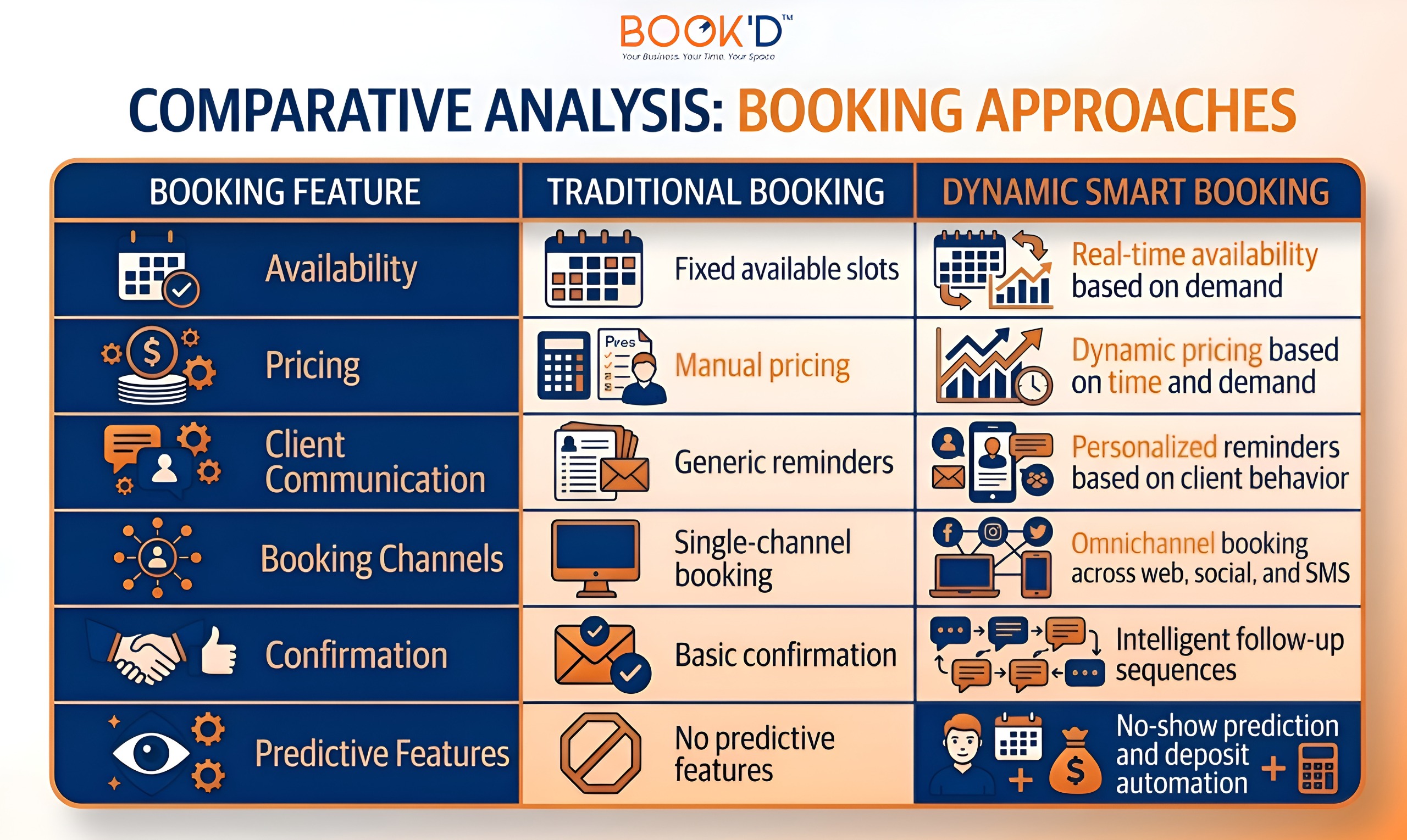
Dynamic availability matters especially for businesses managing shared resources. An hourly studio rental operation, for example, can use smart availability systems to surface high-demand time slots at premium rates while filling lower-demand windows with incentives, all without manual calendar management. That kind of yield optimization, borrowed from the hospitality industry, is becoming increasingly accessible to small service businesses through modern booking platforms.
Omnichannel Booking: Meeting Clients Wherever They Are
The booking journey used to start and end on a website. Increasingly, it starts on Instagram, a Google search result, a text message, or a social media ad. And clients expect to be able to complete the booking without leaving whatever channel introduced them to the business.
Omnichannel booking integration is a major scheduling technology trend for exactly this reason. Platforms that let a client book directly from an Instagram profile, a Google Business listing, a Facebook page, or an SMS link without getting redirected through multiple steps dramatically reduce the friction between discovery and commitment.
For service businesses operating in competitive urban markets, this frictionless discovery-to-booking path is increasingly a big competitive factor. The business that lets someone book in thirty seconds from a social post will capture clients that the business requiring three redirects and a form submission simply won’t.
Automation Depth: Beyond Reminders Into Full Journey Management
Early booking automation was basically just confirmation emails and appointment reminders. Those are still valuable, but the direction of booking automated trends is toward automation that manages the entire client journey, not just the appointment itself.
Pre-appointment automation now includes intake forms sent at the right interval before a visit, preparation instructions tailored to the specific service booked, and personalized welcome messages for first-time clients. Post-appointment automation includes satisfaction check-ins, rebooking prompts timed to the typical return interval for that service type, referral requests sent when satisfaction signals are positive, and loyalty milestone acknowledgments.
For a grounded look at how automation specifically affects operational efficiency, this guide on how online booking automation saves time covers the practical mechanics in detail. The strategic point is that automation depth is moving from a premium feature to a standard expectation. The businesses that implement it fully benefit from both time savings and measurably stronger client relationships.
What This Means for Independent Service Professionals
Trends matter most when they translate into practical decisions. For independent professionals, the implications of these shifts are pretty clear.
The booking system is increasingly the face of the business for both new and returning clients. Investing in a platform that reflects these trends, one that personalizes, integrates, automates intelligently, and meets clients across channels, isn’t really a technology decision. It’s a client experience decision with direct consequences for retention, reputation, and revenue.
We are built around exactly these principles, with tools designed not just for today’s booking needs but for where client expectations and service business operations are clearly heading. The advantage of moving early is real, and it compounds in exactly the way a growing client base does.
FAQs
What are the biggest trends in online booking systems right now?
The biggest trends right now are AI-powered scheduling that personalizes the booking experience and predicts client behavior, deep platform integration that connects booking to CRM and marketing tools, omnichannel availability that allows booking from social media and messaging platforms, and dynamic pricing and availability systems. Together, these trends are moving booking platforms from simple calendar tools to fully integrated client relationship systems.
How will AI change the future of booking software?
AI will mainly change booking software by making it predictive instead of just reactive. Instead of simply displaying available slots, AI-powered systems will learn individual client preferences, anticipate rebooking needs, flag no-show risks, optimize pricing based on demand patterns, and automate personalized follow-up sequences. The result is a system that actively manages client relationships rather than just recording appointments.
Why is omnichannel booking important for service businesses?
Because clients increasingly expect to book from wherever they discover a business, whether that’s a social media profile, a Google search result, or a direct SMS link. Every extra step between discovery and confirmed booking increases the chance of abandonment. Omnichannel booking removes those steps and meets clients in the channel they’re already using, which directly improves conversion rates from new client discovery.
How do booking automation trends affect client retention?
Automation improves retention by making sure consistent, personalized communication happens at every stage of the client journey without requiring manual effort. Automated rebooking prompts, post-appointment follow-ups, and loyalty acknowledgments keep clients engaged between visits and make returning feel effortless. The businesses that actually implement these sequences see measurably higher repeat visit rates than those relying on manual outreach.
What should a small service business look for in a modern booking platform?
Look for platforms that offer AI-assisted scheduling, omnichannel booking capability, deep automation for the full client journey, CRM-style client profiles, dynamic availability management, and integration with the other tools your business uses. Ease of use for both the client and the provider matters just as much as feature depth. The right platform should reduce your administrative workload while actively improving the experience for every client who interacts with your business.