

Most service business owners waste a startling number of their daily hours on non-service chores. Texting appointment confirmation. Manual reminders. Every booking, calendar update. Following up on payments. Repeatedly answering availability queries.
Nothing like that is what you did in business. And it’s not hard work, which is annoying. Time-consuming, repetitive, and relentless. An hour wasted on scheduling admin means less time for clients, growth, or personal life.
Online booking automation is designed to eliminate that task. Always, whenever a client books, reschedules, or cancels. This blog explains how it works, what it saves, and why service workers who switch rarely return.
Online Booking Automation: What It Does
Being explicit is important because the term is widely used. Online booking automation software manages the entire appointment lifecycle without business owner interaction.
When a client books, the system promptly confirms the appointment, updates the calendar, sends a confirmation, and queues reminders. Calendars automatically adapt when clients reschedule. Cancelling frees up the slot for someone else. If booking requires payment, it is performed automatically.
This is the automated booking system’s main function. Every administrative activity associated with an appointment is closed by them, not the business owner.
For salon chairs for rent and solitary studio practitioners, this is crucial. No one handles these chores at the front desk. They fall on the business owner, who normally provides the service, without automation.
Manual Scheduling’s Hidden Time Cost
Most people underestimate how much time manual scheduling takes because it happens in small chunks throughout the day. Two-minute SMS exchange. Five-minute calendar update. Quick call to confirm an email-confirmed appointment.
Each feels minor. They’re significant together. Task-switching research reveals that moving from one task to another adds cognitive cost to these interruptions. As a service provider dealing with a client, a scheduling notification is more than a two-second distraction. Focus disruptions require time to recover from.
In addition to saving task time, scheduling automation technologies eliminate context switching, which fragments a workday.
Where Time Savings Are Most Clear: Meeting Confirmations and Reminders
One of the biggest time drains in service firms is manually confirming and reminding appointments. After setup, automated appointment booking handles both without input.
On booking, confirmation messages are sent. Your configured intervals send reminders 48 and 24 hours before the appointment. Communication is provided to the client. No need to think.
The downstream influence on no-shows is genuine. Timely notifications increase the likelihood that clients will attend or cancel in time to fill the slot. Not only time savings. A revenue protection mechanism is integrated into the system. Rescheduling and Cancelling
Cancellations start a chain of tasks in manual systems. Take it off the calendar. Alert the next waitlist client. Contact the canceled client about rescheduling. All steps require attention and action.
Software activates upon cancellation in automated systems. Slot reopens. Automated notifications notify waitlisted clients. Inclusion of rescheduling links in cancellation confirmations allows clients to select a new time without a lengthy exchange. Collection of payments
After-service payment collection is one of the worst parts of owning a small business. Payment is collected directly during automated appointment booking, so deposits or full payments are made before the appointment.
This is useful for professionals renting private salon suites. Building it into Booking fits the need well.
Automated Booking Systems for Multiple Businesses
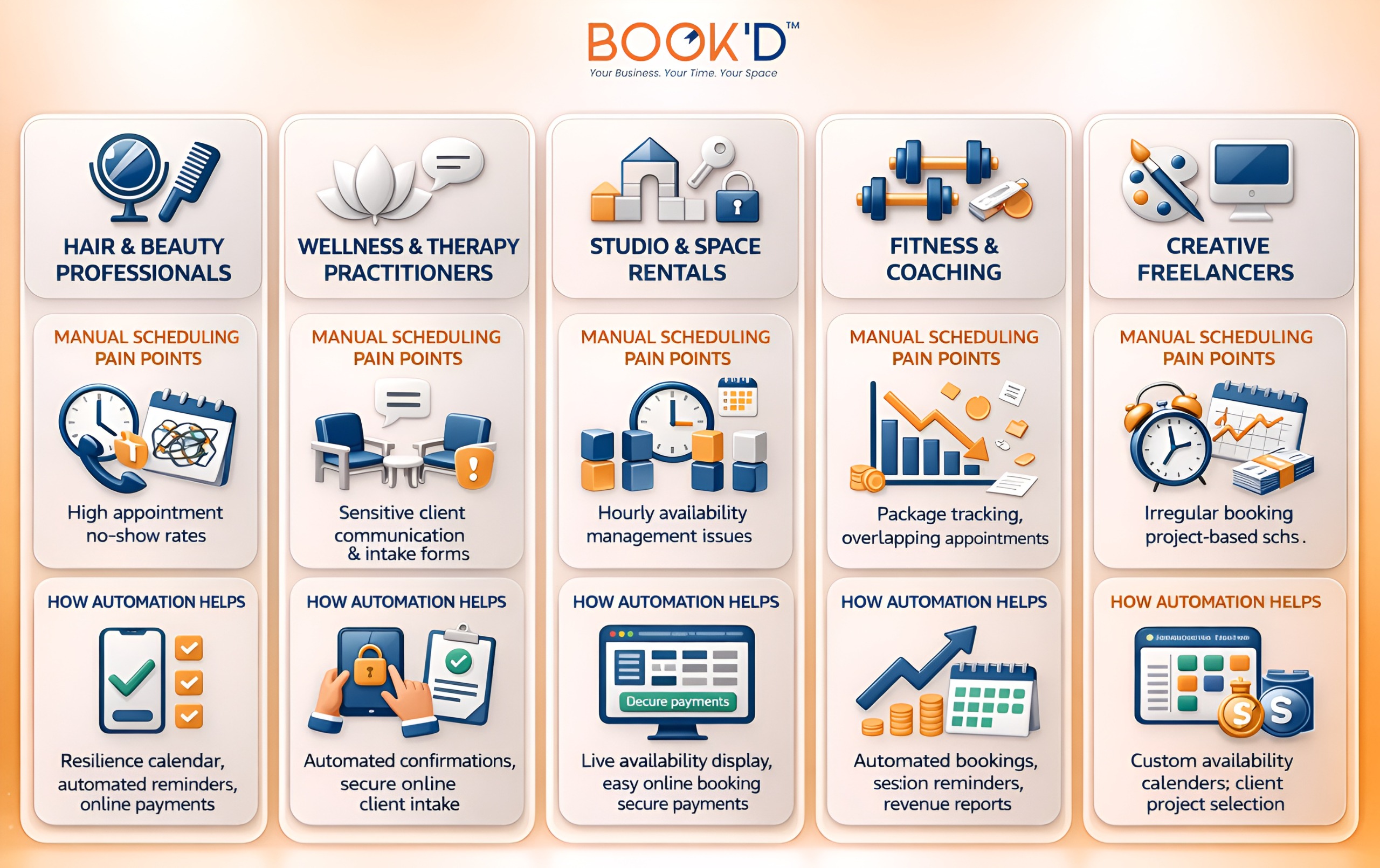
While service businesses implement automation differently, the timesaving reasoning is universal. Hair and beauty professionals with high appointment volume and frequent rescheduling can benefit from automated scheduling solutions such as real-time calendars, reminders, and online payments.
Wellness and therapy practitioners: automated confirmations, intake forms, and form collection at booking.
Studio and space rentals: hourly availability management, multiple users, live availability display, instant booking confirmation.
Fitness and coaching:
package tracking, recurring appointments, automated rebooking, session reminders.
Creative freelancers:
project-based scheduling, irregular hours, custom availability.
The administrative overhead of scheduling is the same across all services, and automation eliminates it.
Scheduling Automation Tool Considerations
Choosing the wrong booking software can cause new problems while fixing old ones. Some considerations before choosing a system.
 The Time Return Compound Effect
The first benefit of online booking automation is less scheduling time. The long-term advantage is also noteworthy.
The mental space previously occupied by administrative duties is now available for other tasks. Continuously delayed strategic judgments. Marketing failed due to scheduling constraints. The rest was skipped because the todo list never ended.
Many service business owners find automatic scheduling more than timesaving. Changes workday texture. It reduces reactive mode, context switching, and low-grade stress from manual tasks waiting. The firm operates more like a system than improvisation.
That shift is tougher to quantify than hours saved, but it may be more meaningful over time.
Time is the only resource that doesn’t scale with effort, therefore every hour saved from manual scheduling admin is an hour for business growth. On that premise, Just-Booked gives service professionals the automated framework to manage a tighter, more efficient operation without complexity. Changing your business’s manual scheduling is worth it.
FAQs
What is online booking automation and how does it work?
Online booking automation software automates appointment scheduling processes, eliminating the need for manual input from business owners. When a client books, the system verifies the appointment, updates the calendar, provides messages, and processes payment if needed without business intervention. To eliminate repetitious scheduling activities from the owner’s plate.
Automatic booking systems can save time for service organizations, with savings varying based on appointment volume and manual processes. Typically, businesses report saving several hours per week after converting to automated systems. Savings add up throughout confirmation messages, reminders, rescheduling, and payment followup, which formerly required individual attention.
Are automated appointment bookings beneficial for solitary operators?
Automated appointment booking is very useful for solo operators who lack support staff for scheduling chores. Every automated confirmation, reminder, and calendar update saves the business owner time. Automation functions as a virtual front desk for independent professionals in salon suites or private studios.
Will clients like automated booking systems?
Most clients like it. Clients across service sectors appreciate the option to schedule at any time, including outside office hours, without calling or waiting. Automated confirmations and reminders alleviate the stress of wondering if a booking was received and recorded. Make automated communications personable and clear, not generic.
Difference between scheduling automation solutions and a plain online calendar?
A simple web calendar displays availability and bookings. Schedule automation tools do so and keep functioning after booking. They provide confirmations, queue reminders, reschedule workflows, integrate payment collection, and cancel without manual intervention. A tool records appointments, while a system handles the full appointment lifecycle.