


There’s a certain kind of friction that quietly kills service businesses. Not bad reviews, not poor service, not even pricing. It’s the small, invisible resistance that builds up every time a potential client tries to book an appointment and hits a wall. A phone that rings out. A DM that goes unanswered for six hours. A website with no booking option at all. In those moments, the business doesn’t just lose a booking. It loses a relationship that hadn’t even started yet.
The shift toward digital booking systems isn’t a trend driven by technology for its own sake. It’s a response to a real and growing expectation from clients who are used to doing everything on their phones, on their schedule, without waiting for a human on the other end to make it happen. Businesses that meet that expectation thrive. Those that don’t are increasingly invisible.
This blog looks at what digital booking actually means in practice, why it matters more than most business owners realize, and how the right system quietly solves problems that most people don’t even know they have until the solution is in place.
What “Digital Booking” Actually Means for a Modern Business
The phrase gets used loosely, so it’s worth being specific. A digital booking system is any platform that allows clients to schedule, confirm, reschedule, or cancel appointments without requiring a direct back-and-forth with the business owner or staff. At its most basic, it’s an online calendar with a booking link. At its most sophisticated, it’s an integrated platform that handles reminders, payments, client history, staff scheduling, and automated follow-ups.
The gap between those two ends of the spectrum is where most of the real business value lives. A basic online form removes one layer of friction. A fully integrated digital appointment booking system changes how the entire business operates, from how new clients experience first contact to how returning clients are retained over time.
For independent professionals and small studios, this matters enormously. Someone running a salon suite for rent doesn’t have a front desk. Their booking system is their front desk. If it’s clunky, slow, or nonexistent, that gap shows in the client experience, whether they realize it or not.
The Real Cost of Manual Scheduling
Manual scheduling has costs that rarely show up on a spreadsheet but are very real. Time spent on back-and-forth messages to confirm a booking is time not spent on the actual work. Phone tag with clients who call outside business hours leads to missed opportunities and frustrated prospects. Double bookings happen. No-shows aren’t followed up on. And the mental overhead of maintaining a calendar manually adds a low-grade stress to the business day that compounds over time.
Modern booking platforms eliminate most of these friction points by design. Automated confirmations mean clients know their booking is secured the moment they make it. Reminder sequences reduce no-shows without requiring any manual follow-up. Cancellation and rescheduling can be handled by the client directly, within whatever rules the business sets.
The time savings alone justify the switch for most service businesses. But time is only part of the story.
How Digital Systems Create Better Client Experiences
The experience of booking an appointment tells a client something about the business before they’ve ever walked through the door. A smooth, professional booking process communicates organization, reliability, and respect for the client’s time. A clunky or nonexistent one communicates the opposite, even if the actual service is excellent.
Online scheduling tools do something that manual systems structurally cannot: they’re available at 2 am when someone is scrolling through their phone and suddenly decides they want to book a session. That midnight impulse booking doesn’t happen if the only option is calling during business hours. It’s a sale that exists or doesn’t exist entirely based on whether the system is in place.
This is especially relevant for high-competition service environments. A professional renting a barber chair for rent in a shared space, for example, is competing not just on skill but on accessibility. The provider whose booking page loads instantly and takes thirty seconds to complete will consistently capture clients that others lose simply because the path of least resistance runs through them.
The Connection Between Digital Booking and Client Retention
Retention is where the compounding value of a good booking system really becomes visible. Getting a client once is marketing. Getting them back is the business.
For a deeper look at how this plays out, this blog on scheduling software for customer retention covers the specific mechanics of how automated booking touchpoints build loyalty over time. The short version is this: the easier it is to rebook, the more often clients do. The more consistently they receive professional reminders and follow-ups, the more reliable the relationship feels. And reliable relationships are retained.
Digital appointment booking creates the infrastructure for that consistency. Automated post-appointment nudges prompt rebooking at exactly the right interval. Saved client profiles mean returning clients don’t re-enter their information every time. Communication feels seamless rather than effortful. All of that adds up to a client experience that encourages loyalty not through incentives alone but through genuine ease.
What to Look for in a Digital Booking Platform
Not all booking tools are built the same, and the right choice depends on how a business operates. A few features that separate genuinely useful platforms from basic calendar tools:
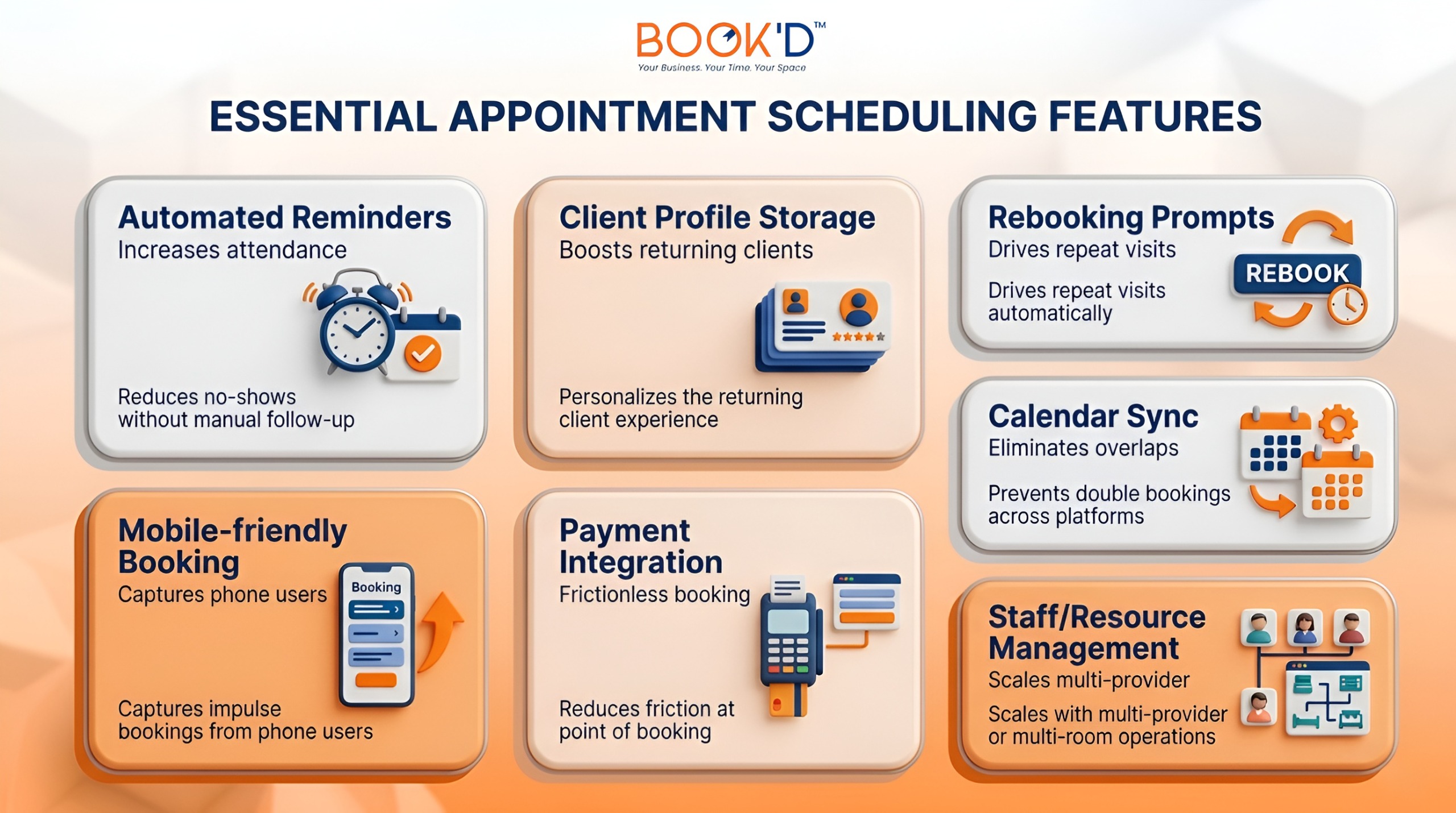
The businesses that get the most from their booking platform tend to use more of these features over time rather than just the basic calendar function. Each additional automation compounds the time savings and client experience improvements that make the platform worth having.
Automation as a Business Growth Tool
There’s a mindset shift worth making here. Most business owners initially think about digital booking as a convenience tool. It saves a bit of time, makes booking easier for clients, and that’s about it. In practice, the businesses that grow fastest through digital systems are the ones that start thinking about automation as a strategic asset rather than an administrative shortcut.
For the broader operational picture, this guide on how online booking automation saves time goes deeper into the compounding efficiency gains that come from removing manual scheduling tasks entirely. The core insight is that every minute recovered from administrative work is a minute available for revenue-generating activity, and those minutes add up to something significant over a month or a year.
Automation also removes the bottlenecks that appear as a business grows. A solo provider managing five clients a day can handle manual scheduling. Managing twenty can’t, at least not without it consuming significant time and mental energy. A digital system scales without that cost.
The Businesses That Benefit Most
Digital booking systems provide value across almost every service industry, but the impact is particularly pronounced in certain contexts.
Independent professionals operating from shared spaces, like those in studio space for rent environments, benefit from having a booking system that presents them professionally without requiring a full office infrastructure. The booking page becomes the business’s front door, and a well-designed one communicates credibility instantly.
High-frequency service businesses like salons, barbershops, wellness providers, and fitness studios benefit from the retention and rebooking features that keep clients cycling back regularly. Appointment-based businesses with premium pricing benefit from reduced no-shows and the professional impression that a polished booking experience creates.
The common thread is that any business where the client relationship is ongoing and repeat visits matter will find that a well-implemented booking system is one of the most leveraged investments they can make.
Building for the Client Experience You Actually Want to Deliver
At the end of the day, the reason to invest in digital booking infrastructure is a simple one. Clients deserve an experience that reflects the quality of the actual work. If the service delivered is professional, skilled, and worth paying for, the path to accessing that service should feel the same way.
We are built around exactly that principle: that the booking experience is part of the service experience, and that modern businesses deserve tools that make it effortless for the right clients to find them, book them, and keep coming back.
FAQs
What is a digital booking system, and how does it work?
A digital booking system is a software platform that allows clients to schedule appointments online without direct back-and-forth communication with the business. Clients visit a booking page, select an available time, confirm their details, and receive an automated confirmation. The business gets a real-time updated calendar, automated reminders go out before the appointment, and follow-up communications can be triggered automatically afterward.
Are digital booking systems worth it for small businesses?
Yes, particularly for small businesses where the owner is also managing operations. The time saved on manual scheduling, the reduction in no-shows through automated reminders, and the improved client experience all contribute to measurable business outcomes. For solo operators and small teams, the return on a modest monthly platform fee is typically realized within the first few weeks of use.
How do online scheduling tools reduce no-shows?
Automated reminders sent 48 and 24 hours before an appointment are the primary mechanism. When clients receive a timely reminder with an easy option to reschedule if needed, the rate of silent no-shows drops significantly. Some platforms also require upfront deposits or card-on-file policies that further reduce no-show rates by creating a financial commitment to the booking.
Can a digital booking system help with client retention?
Directly and measurably. Systems that send post-appointment follow-ups and rebooking prompts keep clients engaged between visits and make returning feel effortless. The easier it is to rebook, the more often clients do. Over time, that ease translates into higher visit frequency, stronger client relationships, and lower churn rates across the business.
What should I look for when choosing a modern booking platform?
Prioritize mobile-friendly design, automated reminders, client profile storage, and payment integration as baseline features. Beyond that, look for platforms that offer rebooking nudges, calendar sync across devices, and reporting on booking trends and no-show rates. The goal is a system that reduces administrative workload while actively improving the client experience, not just a digital version of a paper calendar.