
Think about the last time you tried to book something online, and it was genuinely painful. Maybe the page took forever to load. Maybe you had to call to confirm after already filling out a form. Maybe you got no confirmation email and spent the next day wondering if the appointment was actually set. Frustrating, right? Now flip that around and consider how many of your own clients might feel the same way when they try to book with you.
The customer booking experience is one of those things that gets overlooked because it happens before the service itself. It feels like an admin. But it’s actually the first real interaction a client has with your business, and it shapes everything that follows. A smooth, intuitive booking process builds trust before anyone walks through the door. A clunky one sends people looking elsewhere, often without ever telling you why.
This blog breaks down what actually makes a booking experience good, what gets in the way, and what service businesses can do to make meaningful improvements without overcomplicating things.
Why the Booking Experience Matters More Than Most Businesses Realize
Here’s the thing about friction in a booking flow: people don’t always complain about it. They just leave. They find a competitor whose process is simpler, book there, and you never know the difference. That’s the quiet cost of a poor customer booking experience, invisible churn that never shows up as a complaint but absolutely shows up in your revenue.
There’s also the impression it creates. A business with a polished, seamless appointment booking process signals professionalism before a word is exchanged. Clients assume, reasonably, that a business that handles booking well probably handles everything else well too. The reverse assumption works the same way.
For independent operators running a salon booth rental or a solo wellness practice, this is especially relevant. You don’t have a receptionist managing phone calls and handholding every booking. The system has to do that work for you. If it doesn’t, those bookings either don’t happen or they come with unnecessary friction on both sides.
What a Good Booking Experience Actually Looks Like
Improving the booking experience isn’t about adding more features. It’s about removing the things that slow people down and get in their way.
It Should Work on Any Device
The majority of people booking appointments are doing it on their phones, often while commuting, between tasks, or lying on the couch at 10 pm. If your booking page doesn’t render well on mobile, loads slowly, or requires pinching and zooming to navigate, you’ve already lost a portion of your potential bookings. Booking UX design that doesn’t start with mobile in mind is starting from the wrong place.
A clean, responsive layout with large tap targets, minimal scrolling, and a fast load time isn’t a luxury at this point. It’s the baseline.
Fewer Steps, Fewer Dropoffs
Every additional step in a booking flow is an opportunity for someone to give up. If clients have to create an account before they can see availability, that’s a barrier. If they have to answer five questions before reaching the calendar, that’s friction. The goal is to get someone from “I want to book” to “booking confirmed” in as few clicks as realistically possible.
That doesn’t mean skipping necessary information. It means being thoughtful about what’s truly necessary versus what’s just there out of habit.
Confirmation That Feels Immediate and Clear
Once someone books, they should know instantly. An immediate confirmation screen followed by a confirmation email or text closes the loop on any doubt. It also sets the stage for the reminder communication that comes later, which has a direct effect on whether they actually show up.
Speaking of which, if no-shows are a consistent problem in your business, this blog on appointment reminder systems reduce no-shows covers that side of things in detail. The booking experience and reminder strategy work together, and getting both right is more effective than focusing on just one.
The Payment Piece and Why It Belongs in the Booking Flow
One of the most impactful changes a service business can make is attaching payment to the booking process rather than handling it separately. When clients pay or leave a deposit at the time of booking, no-shows drop significantly. It also removes the awkward end-of-appointment payment conversation and smooths out cash flow.
For businesses operating in shared spaces or an independent studio setup, this matters practically. There’s often no front desk to process payment on arrival. Building it into the booking flow fills that gap automatically.
If you want to go deeper on this, this guide on online booking payment systems simplifies payments, covers the mechanics in full, including what to look for in a payment integration and how to set it up without complicating the client experience.
Common Booking Experience Problems and How to Fix Them
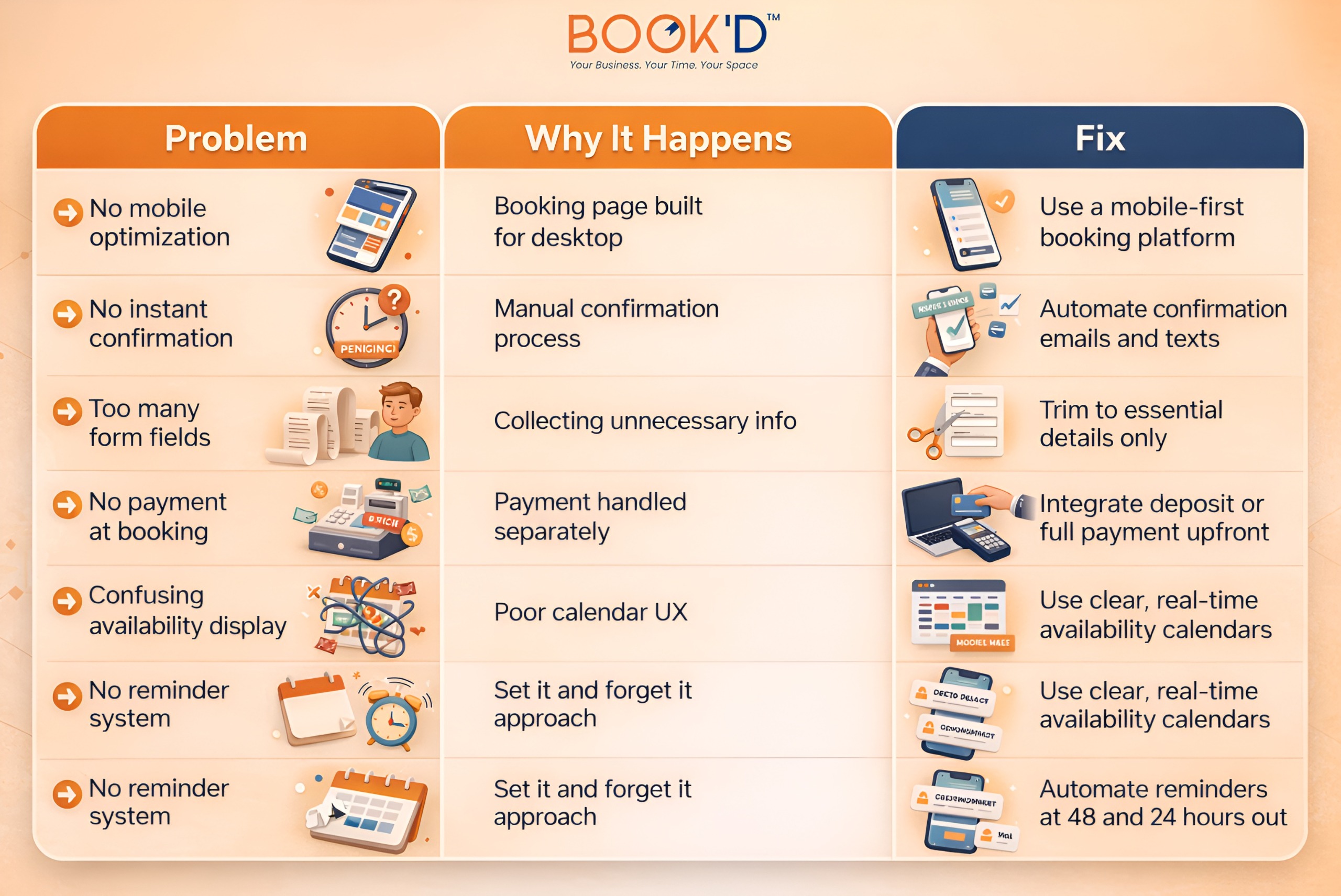 Each of these problems is solvable. Most of them are solvable with the right platform, without custom development or technical expertise.
What Seamless Appointment Booking Does for Client Relationships
There’s a softer benefit to getting this right that doesn’t always make it into the ROI conversation but is genuinely worth naming. When clients can book easily, pay painlessly, and receive clear communication throughout, it lowers the emotional friction of the entire relationship.
They don’t have to chase you for confirmation. They don’t have to remember to bring cash. They don’t show up, unsure of what they booked. That ease accumulates into trust, and trust is what turns a one-time client into someone who books regularly, refers friends, and leaves reviews that bring in new business.
Seamless appointment booking isn’t just operationally useful. It’s a form of client care.
Small Things That Make a Bigger Difference Than Expected
A few practical additions that often get underestimated: A clear cancellation policy visible at booking. Clients appreciate knowing the rules up front. It removes ambiguity and gives you a legitimate basis for enforcing deposits if someone cancels at the last minute.
Service descriptions that actually inform. If someone is booking a service they haven’t tried before, a brief description of what to expect removes hesitation. A lash artist, a massage therapist, and a podcast studio rental all have clients who might be booking for the first time. Help them feel prepared.
A simple way to rebook. After an appointment ends, the easiest new booking to get is the one from a client who just had a great experience. A follow-up message with a direct link to rebook while the experience is fresh has a surprisingly high conversion rate.
None of these requires major technical work. They’re decisions, not features.
FAQs
What makes a booking experience good for clients?
A good customer booking experience is fast, intuitive, and reassuring. Clients want to find availability quickly, complete the booking in a few steps, receive immediate confirmation, and know exactly what to expect. Any friction in that process, slow load times, unclear next steps, or missing confirmation reduces the likelihood they’ll complete the booking or return in the future.
How does booking UX design affect conversion rates?
Booking UX design directly influences how many people who start the booking process actually complete it. Poorly designed flows with too many steps, confusing layouts, or non-mobile-friendly interfaces lead to abandonment. Clean, simple, mobile-optimized designs with clear calls to action consistently convert better because they reduce the mental effort required to book.
Should I require payment at the time of booking?
For most service businesses, yes. Requiring a deposit or full payment at booking significantly reduces no-shows because clients have a financial stake in the appointment. It also improves cash flow and removes the need for awkward payment conversations at the end of a service. Most clients respond positively when the process is framed clearly and handled professionally.
How many steps should an online booking flow have?
As few as necessary. Ideally, a client should be able to select a service, choose a time, enter their details, and complete payment in four to five steps. Every additional step beyond what’s genuinely necessary reduces completion rates. Audit your current flow and ask honestly whether each piece of information you’re collecting is truly required before the appointment.
What’s the best way to reduce no-shows through the booking process?
The two most effective tools are payment at booking and automated reminders. Deposits create financial accountability. Reminders sent at 48 and 24 hours before an appointment give clients the nudge they need to either show up or cancel in time for you to fill the slot. Using both together is consistently more effective than relying on either one alone.