


Running a service business sounds simple from the outside. You offer something, people book it, you show up and do the work. But anyone who has actually managed appointments, studio availability, chair rentals, or client schedules knows how quickly the operational side becomes its own full-time job.
Confirmations that need sending. Cancellations that leave gaps. Double bookings that create awkward conversations. Follow-ups that fall through the cracks. None of it is complicated, exactly, but all of it takes time and attention that could be going somewhere more valuable.
That’s the problem AI booking systems for businesses are genuinely built to solve. Not by adding complexity, but by taking the repetitive, rules-based work off your plate entirely so the people running the business can focus on the part of it that actually requires a human.
This blog walks through how these systems work, what they change operationally, and why more service businesses are treating smart scheduling as a core part of how they run, not an optional upgrade.
What AI Booking Systems Actually Do
The term “AI booking system” covers a range of tools, and it’s worth being specific about what the useful ones actually do.
At the core, an AI booking system connects your availability, your services, and your customer-facing booking experience into a single automated flow. A customer selects what they need, the system checks real-time availability, confirms the slot, sends a confirmation, and updates the calendar. No back and forth. No manual entry. No risk of a gap in communication causing a no-show.
The AI layer goes further than basic automation, though. Smarter systems learn patterns over time. They can flag high-cancellation time slots, suggest optimal scheduling based on historical data, handle waitlists automatically, and adapt to changes without requiring manual reconfiguration every time something shifts.
For businesses where multiple people share a space, like a salon space for rent setup where independent stylists each manage their own clients, this matters a lot. Each person gets their own booking flow, their own calendar, their own confirmations, all without anyone needing to coordinate through a shared front desk that may or may not be staffed at any given time. How AI Scheduling Platforms Reduce the Hidden Cost of Manual Scheduling
The time cost of manual scheduling is easy to underestimate because it rarely shows up as a single large block of lost time. It shows up as two minutes here, five minutes there, a phone call that runs longer than expected, an email thread that needed three exchanges to confirm what should have taken thirty seconds.
Add it up across a week, and it’s significant. Add it up across a year, and it’s genuinely substantial, both in direct time and in the mental overhead of keeping track of it all.
AI scheduling platforms remove most of that friction. Reminders go out automatically on a configured schedule. Cancellations trigger rebooking prompts without any human involvement. Waitlists fill open slots in real time. The calendar stays accurate because it’s being updated continuously, not batch updated at the end of the day when someone finally has a moment.
This guide on AI scheduling automation reducing admin work goes deeper into the operational specifics, but the short version is that the time savings tend to be larger than businesses expect, and the reduction in errors is arguably even more valuable. A double booking costs more than just the time it takes to fix it. It costs trust.
The Customer Side of the Equation
Operational efficiency is one thing. The customer experience is another, and AI booking systems improve both simultaneously, which is part of why they’ve become hard to argue against.
From a customer’s perspective, the ideal booking experience is fast, clear, and available whenever they want to do it. Not during your business hours. Not dependent on someone picking up the phone or responding to a message. Right now, at whatever time they’re thinking about it.
AI booking software tools make that possible. A customer can book a service at 11 pm on a Tuesday, get a confirmation immediately, receive a reminder the day before, and show up knowing exactly what to expect. No uncertainty, no friction, no waiting.
This blog on AI booking chatbots handling customer appointments covers the conversational side of this in more detail, but the underlying point is consistent: customers who have a smooth booking experience start the relationship with the business in a better place. First impressions happen before the actual service does.
For independent professionals, this matters especially. Someone renting a barber chair for rent in a shared suite is competing with larger operations that have full staff. A polished, automated booking experience levels the playing field considerably.
What Smart Booking Systems Look Like in Practice
Not every system marketed as “smart” deserves the label. The ones that actually earn it share a few consistent characteristics.
Real-time calendar sync is nonnegotiable. If the availability a customer sees isn’t current, every other feature becomes unreliable. Integration with existing tools matters too. A booking system that doesn’t talk to the calendar you’re already using creates more work, not less.
Customisation is another real differentiator. A podcast studio rental business has fundamentally different scheduling needs than a lash studio or a fitness instructor. Session lengths differ, buffer times differ, resource requirements differ. A system that forces every business into the same template will create friction somewhere.
Automated follow-up capabilities round out the picture. Confirmation, reminder, postvisit review request, rebooking prompt. The best systems handle this entire sequence without requiring manual triggers, and the businesses using them consistently report stronger retention and more repeat bookings as a result.
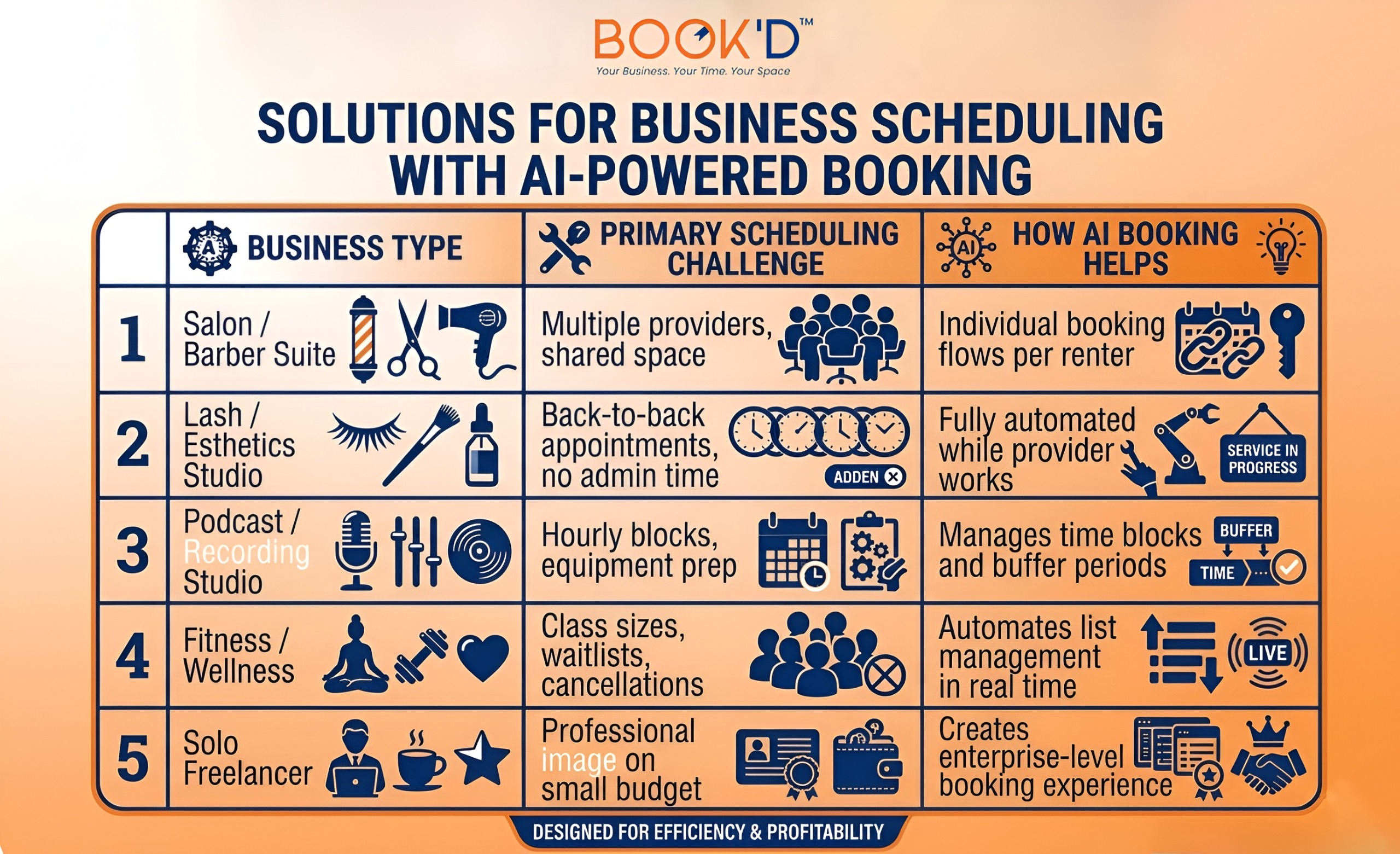
Here’s how different business types tend to benefit most:
 AI Booking Assistant Benefits Beyond the Obvious
The conversation around AI booking assistants tends to focus on time savings and error reduction. Both are real and both matter. But there’s a less-discussed benefit that compounds over time: data.
Every booking interaction generates information. Peak demand periods. Most popular services. Highest cancellation time slots. Average lead time between booking and appointment. Businesses that can see these patterns clearly can make better decisions about pricing, staffing, availability, and marketing.
Most manual scheduling processes produce no usable data, or data that’s buried in calendars and spreadsheets that nobody has time to analyse. AI booking assistant benefits include surfacing that information in a form that’s actually actionable, which shifts scheduling from a purely operational function to something that informs business strategy.
This guide on AI booking assistant benefits covers how this plays out across different business types, but the consistent finding is that the businesses using these tools well tend to grow faster, not just run more smoothly.
Choosing the Right System Without Overcomplicating
The options in this space have expanded significantly, which is good for competition but can make the decision feel harder than it needs to be.
A few questions simplify it considerably. Does it sync with your existing calendar in real time? Can it handle your specific service types and session structures? Does it automate reminders and follow-ups natively, or do those require third-party addons? Is the customer-facing interface clean enough that people won’t abandon it halfway through?
If the answers are all yes, the system is probably worth testing. Most offer trial periods that let you run it alongside your existing process before committing fully. Use that time to actually stress-test it rather than just clicking through the demo flow.
Conclusion
Scheduling has always been one of those operational problems that businesses accept as a cost of doing business. It takes time, it requires attention, and when something slips, someone has to fix it manually while also managing everything else.
AI booking systems for businesses change that calculus. The work still happens. The confirmations still go out, the reminders still fire, and the calendar still stays accurate. It just happens without anyone having to drive it manually every time.
For service businesses of any size, that shift frees up something genuinely valuable: capacity. Capacity to focus on clients, to grow, to rest, to do the work that actually requires a person.
FAQs
- What are AI booking systems for businesses, and how do they work?
AI booking systems are software platforms that automate the scheduling process from end to end. They connect your availability and services to a customer-facing booking interface, handle confirmations and reminders automatically, and keep your calendar updated in real time. The AI layer adds capabilities like pattern recognition, waitlist management, and adaptive scheduling that go beyond basic calendar tools.
- Are AI booking systems suitable for small or independent service businesses?
Yes, and in many ways they’re better suited to smaller operations than large ones. Independent professionals and small teams have no support staff to handle incoming booking requests, which means every manual task falls on the person doing the actual work. AI booking systems fill that gap without adding headcount or significant overhead.
- How do AI scheduling platforms reduce no-shows?
Automated reminder sequences are the primary mechanism. Systems can be configured to send reminders at 48 hours, 24 hours, and the morning of the appointment, which significantly reduces the likelihood that a client simply forgets. Some systems also include cancellation and rebooking flows that fill gaps quickly when cancellations do occur.
- Can AI booking software tools integrate with existing calendar and payment systems?
Most modern systems are built to integrate with popular calendar platforms like Google Calendar and iCal, as well as common payment processors. The depth of integration varies by platform, so it’s worth confirming specific integrations before committing, particularly if you’re relying on a tool that’s central to how you currently operate.
- What’s the difference between a basic online booking tool and a smart booking system?
A basic booking tool lets customers schedule appointments through a digital form. A smart booking system does that and more: it learns from booking patterns, manages waitlists dynamically, automates multistep follow-up sequences, surfaces data insights, and adapts to changes without requiring manual reconfiguration. The gap in day-to-day usefulness between the two is significant.