


People don’t call to book appointments anymore. Not really.
It’s not just a generational thing either. Even people who grew up calling businesses for everything have shifted. The expectation now is that you should be able to handle it yourself, from your phone, in the two minutes you have between other things. No hold music. No “let me check the calendar and call you back.” Just pick a time, confirm it, and be done.
The businesses that have figured this out aren’t necessarily bigger or better funded than the ones still running on manual scheduling. They’ve just stopped making customers work harder than they need to. And a big part of how they’ve done that is with AI.
AI booking assistants aren’t a future-facing concept anymore. They’re running real scheduling workflows right now, across industries that look nothing like each other, handling the kind of routine coordination that used to eat up hours of staff time every week. The businesses using them well aren’t just saving time. They’re building a noticeably better experience for every customer who tries to book with them.
This blog gets into what that actually looks like, where the value shows up, and what separates a genuinely useful AI booking tool from one that’s just wearing the label.
What “AI Booking Assistant” Actually Means in Practice
The word AI gets attached to a lot of things that don’t deserve it, so it’s worth being clear about what a real AI booking assistant is doing versus what a basic scheduling widget does.
A calendar embed that shows your open slots and lets someone pick one is not an AI booking assistant. It’s a form. Useful, but limited. It breaks down the moment a customer has a question, a special request, or a situation that doesn’t fit the standard flow.
An actual AI booking assistant handles the conversation around the booking. Someone messages at 10 pm saying they need something before noon on a weekday, not Tuesday, and ideally with someone who does a specific type of service.
The AI interprets that, responds with relevant options, answers follow-up questions, and moves the person from inquiry to confirmed appointment without a human touching it. It applies your business rules automatically, buffer times, booking limits, deposit requirements, service-specific availability, and updates the calendar in real time.
The better systems recognize returning customers, surface relevant options based on past bookings, and know when something is outside their scope and needs to go to a human. That last part matters more than most people realize. An AI that can’t recognize its own limits creates problems. One that handles 95 percent of interactions cleanly and escalates the other 5 percent gracefully is genuinely valuable.
The Benefits That Actually Move the Needle
Being Available When Customers Decide They Want to Book
This sounds obvious until you think about when people actually make booking decisions.
It’s not usually during business hours. It’s Sunday evening when they’re planning the week. It’s 11 pm when they finally have a quiet moment. It’s during a lunch break when they have exactly four minutes to handle something they’ve been putting off. These are the moments when someone goes from “I should book that” to either booking it or forgetting about it.
If your booking system is unavailable at those moments, or if it requires a response from someone on your team before it confirms, you’re losing a portion of those people every single time. Not dramatically. Just quietly, consistently, in a way that doesn’t show up anywhere obvious but absolutely affects your revenue over time.
AI scheduling automation keeps the window open permanently. The system handles every incoming request with the same quality regardless of when it arrives. That consistency is worth more than most businesses calculate when they’re evaluating whether an AI booking tool is worth the investment.
Cutting No-Shows Without Chasing People
No-shows are one of those problems that feel minor on any given day and genuinely damaging when you add them up across a month.
The cause is almost always the same. Someone books with good intentions, time passes, the appointment slips their mind, and they don’t show. It’s rarely malicious. It’s just what happens when the reminder workflow depends on a person remembering to send it.
AI appointment automation removes the human dependency from that workflow entirely. Confirmation goes out the moment the booking is confirmed. Reminders follow at whatever intervals make sense for your business. If someone needs to reschedule, the system handles that conversation and finds a new slot without anyone on your team getting involved. The no-show rate drops because the communication is consistent in a way that manual outreach simply isn’t.
Making the Booking Experience Feel Effortless
Here’s the part that gets underweighted in these conversations. The booking experience is part of the customer relationship. It’s often the very first real interaction someone has with your business after deciding they’re interested. And the quality of that interaction shapes how they feel about everything that follows.
An AI customer booking tool that responds instantly, communicates clearly, and gets someone from inquiry to confirmed appointment in under two minutes creates a specific kind of impression. It says that this business is organized, professional, and respectful of people’s time. That impression carries into the actual service. Customers arrive in a different headspace than they do after a frustrating booking experience.
The inverse is also true. Phone tag to get an appointment. A confirmation that arrives the next morning. No reminder until it’s too late to plan accordingly. A rescheduling request that requires three email exchanges to resolve. The service itself might be excellent. The surrounding experience undermines it in ways that are hard to quantify but easy for customers to feel.
Real Businesses, Real Applications
The use cases are more varied than you might expect.
Independent professionals renting salon chair for rent setups in shared spaces use AI booking assistants to run their entire client scheduling without front desk support. The system manages availability, collects deposits, and sends prep information automatically. For a solo practitioner, that’s not a nice-to-have. It’s the difference between having evenings free and spending them on admin.
Content creators and producers who work from hourly studio rental spaces use similar tools to manage session bookings, coordinate collaborator schedules, and handle last-minute rescheduling without back-and-forth emails. When you’re paying for studio time by the hour, an empty slot because of a scheduling miscommunication is a direct financial loss. AI scheduling automation closes most of those gaps before they happen.
Larger service businesses use it differently. A wellness center running multiple practitioners, several service categories, and a waitlist across two locations isn’t going to manage that manually without a dedicated admin team. AI handles the volume, the routing, the reminders, and the rescheduling workflow while the humans focus on the actual service delivery.
What Separates a Good AI Booking Tool From a Mediocre One
Since the market has filled up with tools wearing the AI label, it’s worth knowing what to actually look for.
Natural language handling is the clearest test. Give the system a conversational, slightly messy request, the kind a real customer would actually send, and see how it responds. Does it interpret the intent and reply helpfully? Or does it fall back on a rigid format that only works when the customer phrases things exactly right? The answer tells you a lot about whether you’re looking at genuine AI or a sophisticated autocomplete.
Integration depth is the next thing. An AI booking assistant that doesn’t talk to your calendar, your payment system, and ideally your CRM is adding complexity rather than reducing it. The value comes from the pieces working together. Standalone tools that require manual syncing are just creating a different kind of administrative overhead.
Customization matters more than most vendors advertise. Your business has specific rules about how bookings work. Buffer times between appointments. Service-specific availability. Deposit requirements for certain booking types. Waitlist logic. The system should reflect your actual operation, not force you to simplify your operation to match its defaults.
And honestly, how it handles the edge cases. Every booking system looks good in a demo with a cooperative customer making a standard request. What matters is what happens when someone sends a confusing message, tries to book something that isn’t available, or needs something the system wasn’t configured for. The AI tools worth using handle those moments gracefully.
A Practical Breakdown of What AI Booking Handles
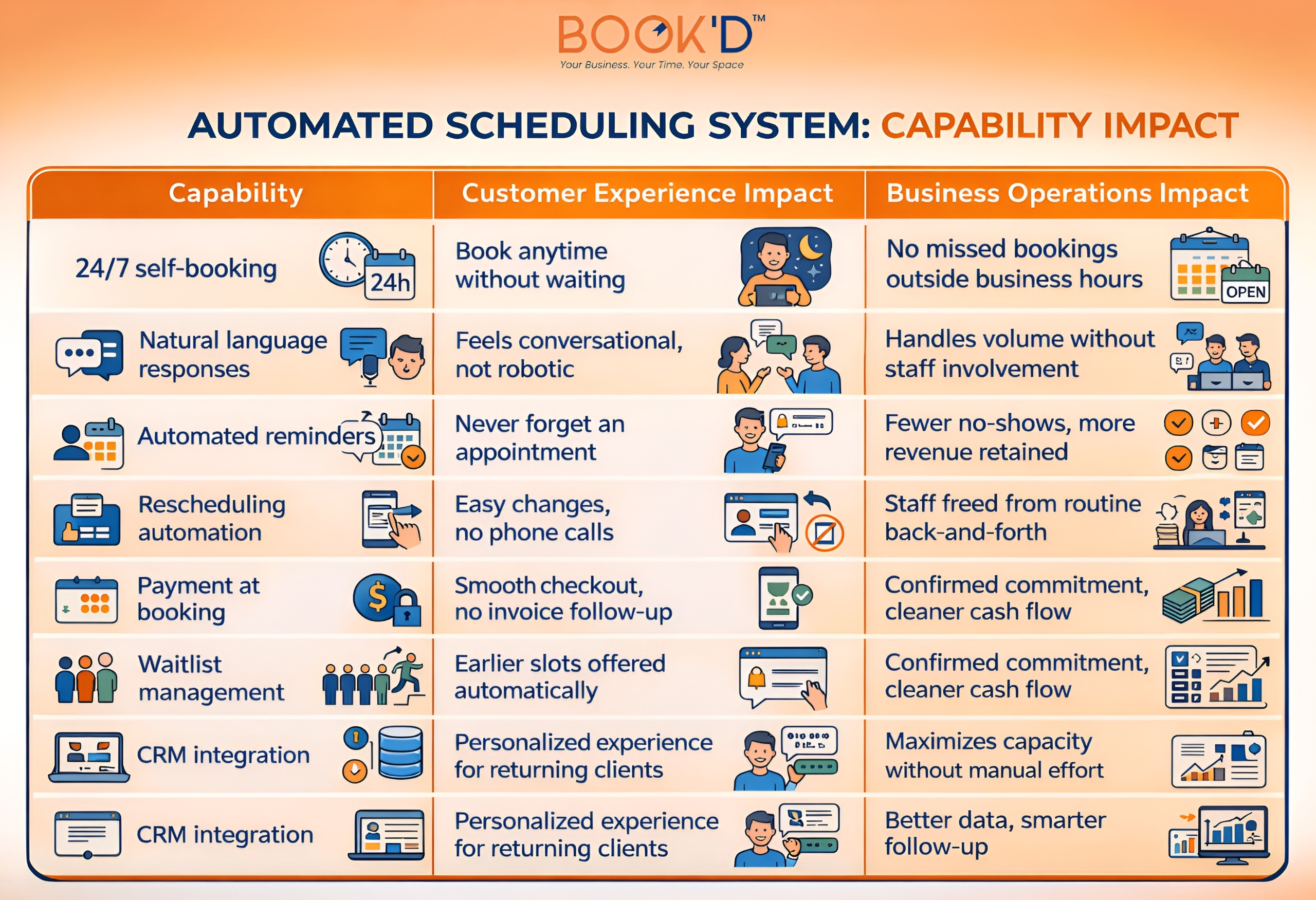 FAQs
FAQs
Why do AI booking assistants benefit service businesses?
Automated reminders for humans help reduce the number of no-shows. Problems caused by manual scheduling become a thing of the past. Where every appointment is money in your pocket from service businesses, AI scheduling automation keeps the schedule fuller and the costs under control without adding staff. Improvements to the customer experience generally wait for time retention statistics.
What is the actual mechanism by which AI scheduling automation reduces no-shows?
Continuous, time-based support: The system immediately sends confirmation messages after each booking. It follows up at regular intervals with reminders until an appointment looms large. When a customer wants to reschedule, the system controls that exchange directly and simply begins another time automatically.
Is there much installation work for an AI schedule for a small business customer to book a solution?
Most stylish, current area administration systems today are operable within a day or two, even if the operator has no technical knowledge at all. Default setup comprises getting linked to your schedule, defining what type of services you provide whenever they are offered, and all your own rules: business as those of the platform itself.
Does AI appointment automation manage reschedules without human intervention?
Yes, and this capability is practically valuable. The system crowdsources possible alternatives, offers them, and updates the schedule when a new time is chosen automatically. Also, it reconfirms on its own. If waitlist management has been enabled, cancellations prompt the system to notify customers waiting without anyone from the team needing to take action.
What’s the difference between an AI booking assistant and a regular online scheduling tool?
A standard scheduling tool lets customers book time from a table or list of times. An AI booking assistant does everything else you would do online, such as handling questions and exceptions to the procedure without confounding people who don’t fit nicely into your mold for these matters. For a business, operational differences could mean that fewer edge cases require human input. And multiplied out across thousands of transactions a day, seconds become hours very quickly.