

Most people have abandoned a booking process midway because it felt like too much work. A form that took forever to load. An email that needed a reply before anything could be confirmed. A phone call during business hours that just wasn’t convenient. It’s frustrating on the customer’s end, and it’s costing businesses real money on the other side.
That’s where AI booking chatbots are genuinely changing things. Not in the “buzzword of the year” kind of way, but in a quiet, practical sense that’s making a real difference for salons, studios, freelancers, and service providers who can’t afford to be glued to their inbox all day.
This blog walks through how these tools actually work, what makes them effective, and why more service businesses are switching to automated scheduling instead of doing things the old way.
What a Chatbot Actually Does When a Customer Wants to Book
Let’s be specific, because “AI chatbot” can mean a lot of different things depending on who’s selling it.
When a customer lands on a booking page or opens a chat window, an AI booking chatbot picks up the conversation immediately. It asks the right questions: What service do you need? When does it work for you? Do you have a preferred staff member? It pulls live availability from the calendar, confirms the slot, and locks in the appointment, all without any human involvement.
What used to require back-and-forth emails or a receptionist on the phone now takes about two minutes. The customer gets a confirmation. The business gets a booked appointment. Nobody had to wait.
For something like a salon booth rental setup where multiple stylists share a space and manage their own schedules, this matters a lot. Each professional can run their own booking flow without relying on a shared front desk that may or may not be staffed at any given hour.
Why Chatbot Appointment Scheduling Reduces the Friction That Kills Conversions
Here’s something worth thinking about: most people who abandon a booking process aren’t leaving because they changed their mind. They’re leaving because the process made them work too hard.
Chatbot appointment scheduling solves this by meeting customers where they already are, on their phones, on social media, on the business website, and at 11 pm when they finally have a free moment. The bot doesn’t clock out. It doesn’t go on lunch. And it doesn’t ask customers to call back during business hours.
This always-on availability is especially valuable for independent service providers. Consider someone renting a lash room for rent in a shared studio space. They’re probably doing lash sets back-to-back most of the day. Answering DMs and booking texts while working isn’t realistic. A chatbot handles that layer entirely, so they stay focused on the client in front of them.
The other piece here is consistency. A human might forget to ask about addons or fail to mention a cancellation policy. A chatbot delivers the same experience every single time, which protects the business and sets clearer expectations for the client.
The Operational Side: How AI Scheduling Automation Reduces Admin Work
There’s a version of this conversation that focuses entirely on the customer experience, but the business side is just as important.
When scheduling is manual, it creates a category of work that never fully goes away. Confirming appointments. Sending reminders. Updating calendars when someone reschedules. Following up on no-shows. All of it takes time that could go toward actual billable work or rest.
AI scheduling automation handles most of this automatically. Reminders go out on a set schedule. Cancellations trigger rebooking prompts. Waitlists fill open slots without anyone making a call. The calendar stays accurate because it’s being updated in real time.
For growing service businesses, this is genuinely significant. The time savings alone can justify the switch, but the reduction in human error adds another layer of value. Double bookings become nearly impossible. Missed confirmations stop slipping through.
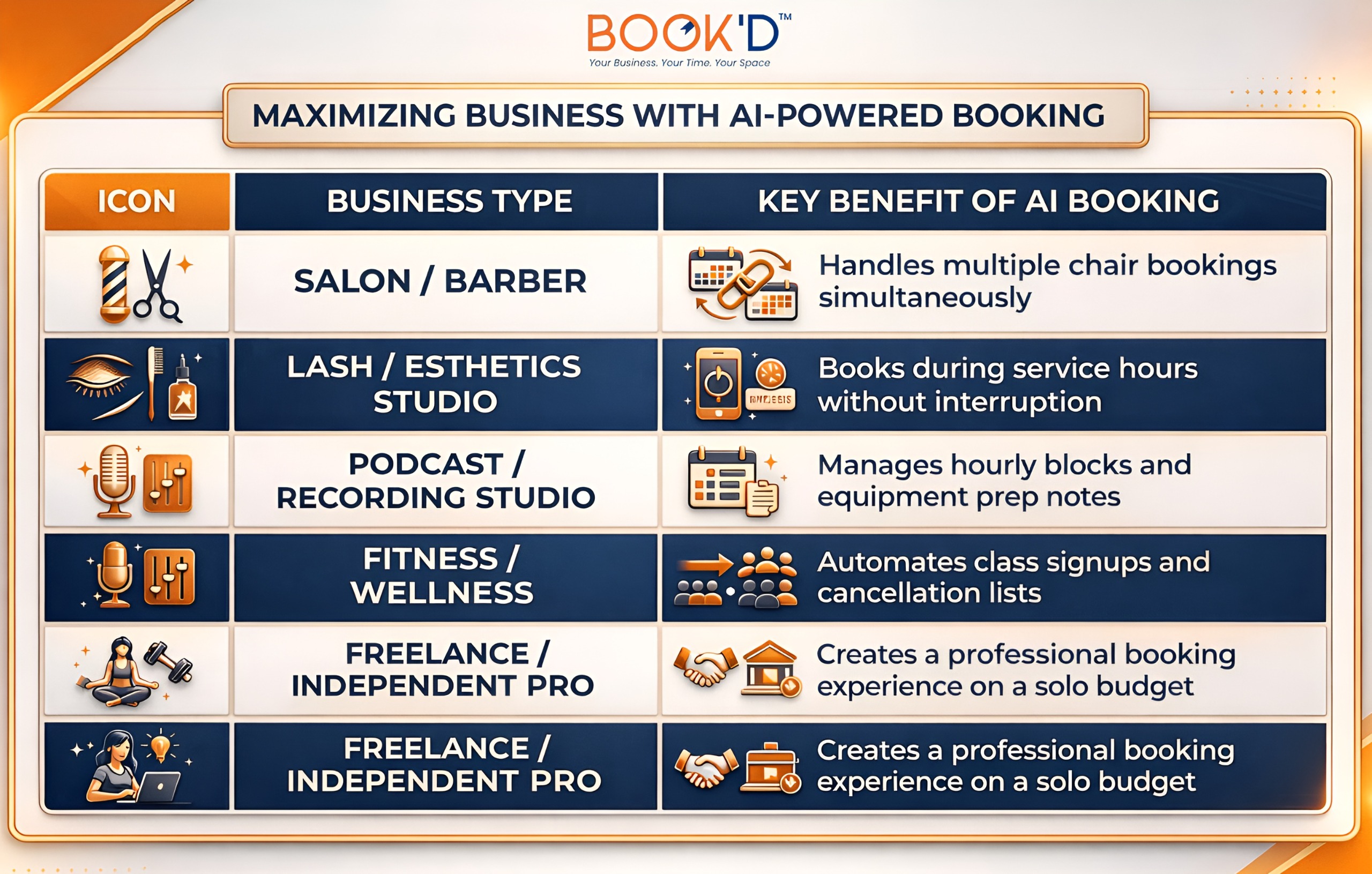
This blog wouldn’t do the topic justice without acknowledging how the AI Booking Assistant Benefits stack differently depending on the type of business.
Here’s a quick breakdown:
 How AI Customer Booking Chatbots Improve the Experience After the Appointment is Set
Booking the appointment is just the beginning. What happens between confirmation and the actual visit shapes how the customer feels when they walk in.
A well-built AI customer booking chatbot stays in the loop after confirmation. It sends a reminder 24 hours out. It provides directions or parking notes if those are configured. It follows up post-visit with a review request or a prompt to rebook. The whole journey feels more intentional, even though most of it is automated.
This kind of structured follow-through builds trust. Customers feel like the business is organised and attentive, which reflects well on the brand even when no human was involved in the process.
What to Look for in Automated Booking Chatbots
Not every chatbot is built the same. Some are glorified contact forms with a chat bubble. Others actually understand natural language, adapt to customer inputs, and integrate cleanly with existing calendar tools.
When evaluating automated booking chatbots, a few things are worth prioritising. Calendar sync is nonnegotiable; it needs to pull real-time availability, not a snapshot from six hours ago. Customisation matters too, because a barber shop and a podcast studio rental have completely different booking flows, and they shouldn’t be forced into the same template.
Reminder and follow-up automation should be built in, not an add-on. And the interface needs to be clean enough that customers don’t bail out halfway through because they can’t figure out what the bot is asking.
The best systems feel invisible. The customer just books. The business just shows up.
Conclusion
Scheduling has always been one of those operational problems that businesses accept as a given. It takes time, it requires attention, and when something slips, someone has to fix it manually.
AI booking chatbots don’t eliminate the need for great service. They just remove the unnecessary friction that gets in the way of delivering it. For solo professionals, growing studios, and multichair spaces alike, the shift toward automated booking isn’t about replacing the human touch. It’s about protecting it by freeing up time and energy for the work that actually requires a person.
Salon Suites for Rent Chicago is built around exactly that idea: less admin, more focus, and a booking experience that works for everyone involved. Frequently Asked Questions
- How do AI booking chatbots handle rescheduling or cancellations?
AI booking chatbots manage rescheduling and cancellations automatically. When a customer requests a change, the bot checks available slots in real time, presents options, and updates the calendar without any manual input. Most systems also trigger waitlist notifications so open slots get filled quickly.
- Are AI booking chatbots suitable for small businesses or solo service providers?
Yes, they’re often a better fit for smaller operations than large ones. Solo providers, especially those managing their own schedules while actively working with clients, benefit the most because they have no support staff to handle incoming booking requests. A chatbot fills that gap without adding overhead.
- Can chatbot appointment scheduling integrate with existing calendar tools?
Most modern booking chatbots sync with popular calendar platforms like Google Calendar and iCal. This ensures availability is always current and prevents double bookings. Before choosing a system, it’s worth confirming which integrations are supported natively versus which require a third-party connector.
- What happens if a customer has a question that the chatbot can’t answer?
Quality systems are designed to recognise when a query falls outside their scope and escalate accordingly, usually by directing the customer to a human contact, an email address, or a FAQ page. The chatbot handles the straightforward bookings; exceptions get flagged for human follow-up.
- Is customer data safe when using an AI booking chatbot?
Reputable booking platforms use encrypted data storage and comply with relevant privacy regulations. Businesses should review the privacy policy of any chatbot platform they adopt and ensure it aligns with how they’re expected to handle customer information in their industry.