


Owning a space sounds like a dream. Your name on the door, a lease nobody can take from you, the satisfaction of building equity in something permanent. For a certain kind of business, at a certain stage of growth, that makes complete sense. But for the majority of independent service professionals, the traditional path of signing a long-term commercial lease and taking on the full weight of a dedicated space is one of the most expensive assumptions in the industry.
The assumption is that owning or holding a long commercial lease signals success, stability, and seriousness. In reality, for a solo esthetician, a barber building a clientele, a lash artist, a podcaster, or a photographer, the overhead of a fully committed space often creates exactly the financial pressure that prevents the business from growing the way it should. You’re paying for square footage you don’t always use, carrying fixed costs that don’t flex with revenue, and tying up capital that could be invested in the skills, tools, and marketing that actually grow a service business.
The rent vs own workspace conversation looks very different when you run the real numbers and think clearly about what a service professional actually needs from a physical space to do excellent work and serve clients well.
The Real Cost of Committing to a Space Too Early
Most service professionals who have signed a commercial lease before they were truly ready tell the same story. The space felt like a milestone. The first few months were exciting. Then the slower weeks came, the ones every business has, and the fixed monthly rent didn’t slow down with them.
Commercial leases, even modest ones, carry obligations that extend well beyond the monthly rent figure. There’s liability insurance, utilities, maintenance, equipment, and often fitout costs to make the space functional for the specific service being offered. When you add it all together, the true cost of a dedicated commercial space frequently runs two to three times the base rent figure. For an independent professional still building a client base, that financial load can become genuinely suffocating.
The workspace cost savings available through flexible renting aren’t just marginal. For many independent operators, they’re the difference between a business that has the financial breathing room to invest in itself and one that is perpetually stretched thin servicing its overhead.
What Flexible Workspace Actually Gives You
Flexible workspace benefits go beyond the obvious financial ones, though those are significant. What renting on flexible terms really provides is optionality, and optionality is extraordinarily valuable in the early and mid stages of a service business.
When your space commitment scales with your actual usage, slow periods don’t become crises. A week with fewer bookings means lower space costs rather than the same fixed overhead against reduced revenue. That relationship between cost and activity is how a service business maintains financial health through the inevitable fluctuations that every independent professional experiences.
Beyond cost flexibility, renting allows geographic and operational experimentation that ownership forecloses. A barber who rents a barber chair for rent in a shared professional space can test different neighborhoods, different client demographics, and different pricing structures without the commitment of a long lease tying them to a location that might not be optimal. That freedom to learn and adjust is enormously valuable in the early stages of building a practice.
The professional environment that comes with well-managed shared spaces also matters more than many people expect. Clients form their impression of a service provider partly through the environment in which they receive the service. A clean, well-designed shared professional space often creates a better client experience than a hastily fitted solo studio at the same price point, because the shared costs allow amenities that a solo operator couldn’t justify on their own.
The Kinds of Spaces That Make This Model Work
The flexible workspace market for service professionals has matured considerably. The options available now are genuinely diverse, and matching the right space type to the specific service makes a significant difference in both experience and economics.
For beauty and wellness professionals, salon suites for rent in professionally managed buildings offer a middle ground between renting a booth in someone else’s salon and running an independent commercial space. The suite is yours during your operating hours, clients experience it as your dedicated environment, and the management overhead is someone else’s problem.
Lash artists, estheticians, and massage therapists often find that renting a dedicated treatment room by the hour or the day is the most efficient model, particularly during the phase of building a clientele that doesn’t yet justify a full-time dedicated space. The room is equipped, the environment is professional, and the cost tracks directly with revenue-generating activity rather than running continuously whether or not the space is in use.
For content creators, coaches, and professionals in adjacent fields, the podcast and recording studio market has developed similarly. Someone looking to rent podcast studio space now has access to fully equipped professional studios at hourly or daily rates that would have been impossible to access as a solo operator a decade ago, making professional-quality audio and video production economically realistic for independent creators at any stage.
Rent vs Own: A Practical Comparison
The decision framework is worth laying out clearly because the emotional pull toward ownership can sometimes cloud the financial reality.
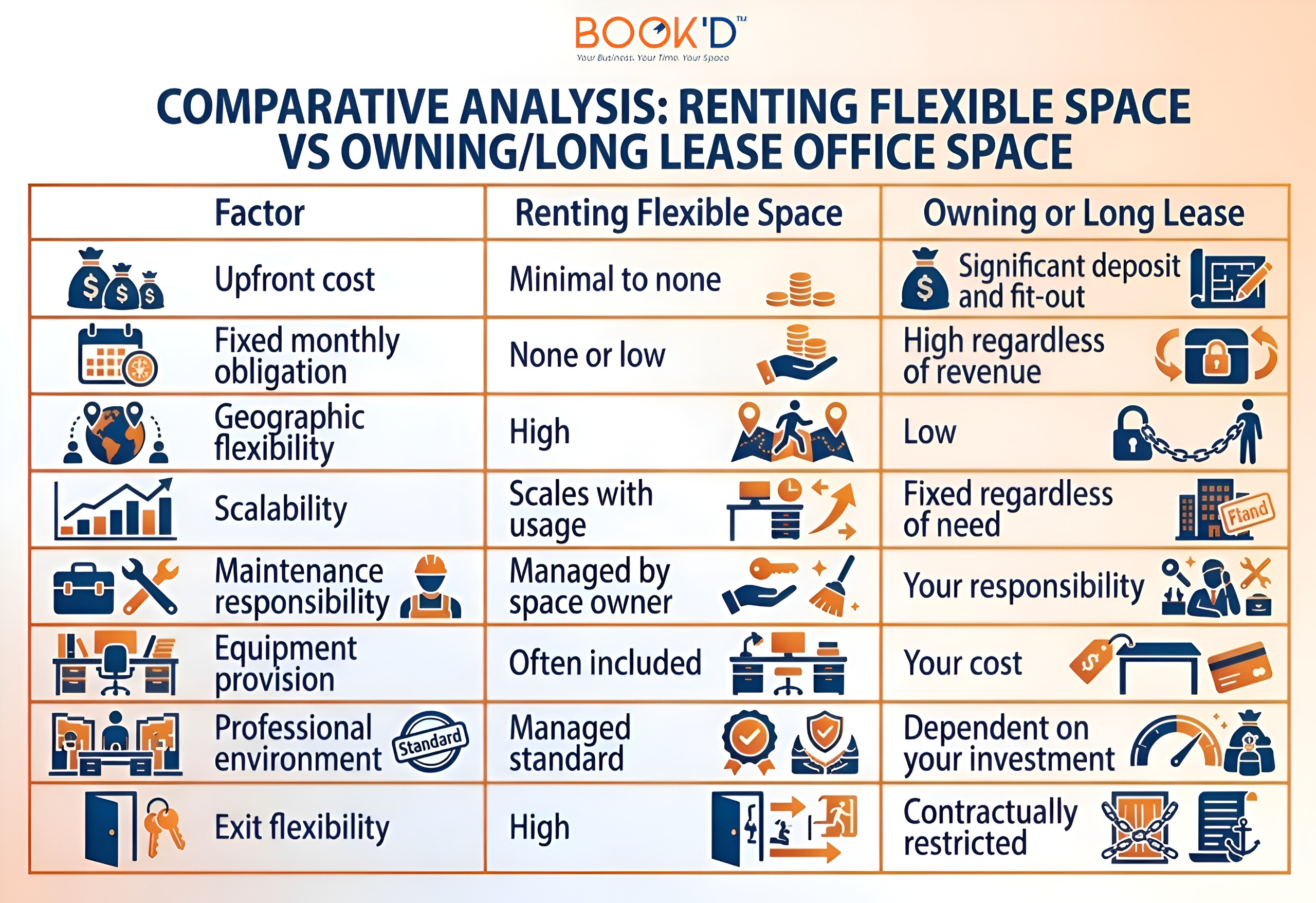
The table makes the economic logic clear for most situations. The cases where long-term commitment to a dedicated space makes sense are specific: high-volume operations with predictable demand, businesses that have genuinely outgrown shared environments, and situations where the branding value of a dedicated location is a core part of the business model. For most independent service professionals, particularly those still growing their client base, those conditions don’t yet apply.
Affordable Business Spaces and the Growth Stage Advantage
There’s a specific advantage to affordable business spaces that often goes unmentioned in these conversations: the capital preserved by not overcommitting to fixed overhead can be reinvested in the things that actually accelerate a service business’s growth.
Advanced training, better tools and equipment, professional photography, a quality booking system, targeted local marketing, these are the investments that grow a client base and justify higher pricing. A professional who spends two thousand dollars less per month on space overhead than their competitor and redirects that capital toward skill development and client acquisition will, in most cases, build a stronger business faster than one carrying unnecessary fixed costs.
This is the compounding advantage of the flexible workspace model. It’s not just that the costs are lower in the short term. It is the financial flexibility that enables a different quality of strategic decisionmaking across the business.
Matching the Model to Your Stage of Business
The practical question isn’t whether flexible renting is theoretically better. It’s whether it’s the right fit for where your business actually is right now.
For a professional in the first two years of building a client base, flexible renting is almost always the right answer. The priority at that stage is client acquisition, skill development, and cash flow management. Locking into significant fixed overhead before the revenue base justifies it creates pressure that works against all three of those priorities.
For a professional with an established, predictable client base who is genuinely constrained by the limitations of shared spaces, the conversation about a more permanent commitment starts to make sense. But even then, the question is whether the premium for dedicated space generates a return in client experience or operational efficiency that justifies the cost differential.
For most service professionals reading this, the honest answer is that the flexible model has more runway left in it than the pressure to “level up” to a permanent space would suggest. The milestone isn’t space. It’s the client base, the reputation, and the revenue consistency that make any space decision a good one.
Just-Booked connects service professionals with flexible, professional spaces designed around how independent operators actually work, with booking infrastructure that makes managing your space and your schedule part of the same seamless system.
FAQs
Is it better to rent or own a workspace as a service professional?
For most independent service professionals, renting flexible workspace is the stronger financial and strategic choice, particularly in the growth phase of a business. Renting eliminates high upfront costs, keeps overhead variables rather than fixed, and preserves capital for the investments that actually grow a client base. Ownership or long-term leasing makes more sense once revenue is consistently high and predictable enough to justify the fixed commitment.
What are the main benefits of renting a flexible workspace?
The primary benefits are financial flexibility, lower upfront costs, the ability to scale space usage with actual demand, and freedom from maintenance and management responsibilities. Beyond the economics, flexible spaces typically offer professional environments that are fully equipped and managed to a consistent standard, which benefits the client experience without the operational overhead of running a fully independent location.
How much can a service professional save by renting instead of leasing?
The savings depend significantly on location and industry, but independent service professionals who shift from a dedicated commercial lease to flexible renting often reduce their effective space costs by forty to sixty percent when total costs, including utilities, maintenance, insurance, and equipment, are factored in. In high-cost urban markets, the differential is often larger.
What types of service professionals benefit most from flexible workspace rental?
Beauty and wellness professionals, barbers, lash artists, estheticians, massage therapists, photographers, coaches, and content creators are among the service professionals who benefit most from flexible workspace models. The common thread is that these are businesses where usage is appointmentbased, client relationships are personal, and the space requirement is for professional service delivery rather than continuous occupancy.
Can renting a workspace look professional enough to impress clients?
Absolutely, and in many cases a well-managed shared professional space creates a better client impression than a solo operator’s independent studio at a comparable price point. Modern shared professional spaces are designed specifically to present well to clients, with consistent maintenance, quality fitout, and amenities that would be difficult for a solo operator to justify economically. The professional impression a client receives is far more determined by the quality of the space and the service than by whether it’s exclusively occupied.