

Renting a workspace sounds simple until you’re actually doing it. You find a space that looks good in photos, the price seems reasonable, and then somewhere between signing and showing up for your first client, you discover the ventilation is inadequate, the booking system is unreliable, or the location adds twenty minutes to every client’s commute. None of those problems was obvious from the listing. All of them were avoidable.
Choosing workspace rental well is a skill. Not an especially complicated one, but it requires knowing what questions to ask and what details to evaluate before you commit, rather than after. The wrong space doesn’t just waste money. It can actively undermine the client experience you’re trying to create, limit the kind of work you can do, and erode the professional credibility you’ve spent time building.
This blog is designed to give you a clear, practical framework for evaluating rental spaces across different professional contexts, from beauty and wellness to creative studios to professional services. Whether you’re booking by the hour or considering a longer arrangement, the same core principles apply.
Start With Purpose, Not Price
The Most Expensive Mistake in Workspace Rental
The most common error people make when renting workspace is leading with price. A cheaper space that doesn’t fit your work costs more in the long run than a more expensive space that does. Lost clients, compromised quality, rebooking fees, and the reputational cost of an unprofessional environment all have real dollar values that rarely appear in the hourly rate comparison.
A good renting workspace guide starts with a different question entirely: what does this space need to do? The answer varies more than most people expect. A lash artist’s requirements are nothing like a podcaster’s. A barber’s setup needs are different from a photographer’s. A business consultant meeting clients’ needs is a completely different environment from a yoga instructor running a private session.
Getting specific about functional requirements before you start browsing listings narrows the field dramatically and keeps you from wasting time evaluating spaces that look appealing but don’t actually fit the work.
Building Your Workspace Rental Checklist
A practical workspace rental checklist works across two categories: non-negotiables and nice-to-haves. Non-negotiables are the requirements without which the space simply doesn’t work for your purposes. Nice-to-haves improve the experience but aren’t deal-breakers if absent.
For most service professionals, non-negotiables include appropriate square footage, relevant utilities and infrastructure, adequate lighting, privacy where the work requires it, and accessibility for clients. Nice-to-haves might include on-site parking, aesthetic quality, natural light, proximity to complementary businesses, and specific amenity packages.
Writing this list before you look at a single listing gives you an evaluation framework that holds up under the pressure of seeing a space you like the look of. Confirmation bias is real. Once you’ve decided you want a space, you start overlooking the things that don’t fit. The checklist prevents that.
What to Physically Evaluate Before Booking
Infrastructure That Matches Your Work
Different work requires different infrastructure, and this is the area where the most consequential mismatches happen. Beauty professionals need specific plumbing configurations, appropriate ventilation for chemicals, accessible power for equipment, and lighting setups that let them work accurately. A salon space for rent that doesn’t have proper ventilation isn’t just uncomfortable; it can create genuine health risks for both the professional and the client.
Audio and content professionals need acoustic treatment, not just quiet. A room that sounds acceptable to the ear during a brief visit can produce unusable recordings when a microphone is actually running. Before booking any podcast studio rental arrangement, spend a few minutes recording test audio in the space and listening back with headphones. The difference between a treated room and an untreated one is immediately apparent, and it’s not fixable with post-production.
For anyone in the beauty or wellness space, this guide on starting a beauty business without opening a full salon is worth reading before you evaluate spaces. It frames the rental decision within the broader context of building a professional practice, which changes what you’re actually looking for in a space.
Lighting, Privacy, and Client Comfort
Lighting is evaluated differently depending on your discipline. Photographers and videographers need controllable artificial light and ideally adjustable natural light as well. Beauty professionals need bright, accurate lighting that doesn’t cast shadows across working areas. Therapists, coaches, and wellness practitioners need warm, non-clinical lighting that supports the kind of relaxed, open environment their work depends on.
Privacy is the other non-negotiable for most client-facing work. A session that can be overheard by people in adjacent spaces, or a treatment room that isn’t fully closed, creates a comfort problem that no amount of professional skill compensates for. Clients share information, remove clothing, discuss personal matters, and make themselves vulnerable in service appointments. The environment needs to honor that vulnerability.
Commercial space tips that get overlooked: test the door. Close it, stand inside, and listen. Assess whether sounds from adjacent spaces or hallways carry through. Check whether windows face other windows or a public area where passersby can see in. These are the kinds of details that don’t show up in listing photos and matter significantly in practice.
Location, Access, and the Client Experience
Distance Is a Filter, Not Just a Convenience
Location matters differently for different types of service professionals. For anyone whose clients travel to them, the accessibility of the space is a direct factor in booking rates and client retention. A beautiful studio that’s difficult to reach by public transit, has inadequate parking, or is located in an area clients find unappealing will generate cancellations and reduce new bookings regardless of how good the space itself is.
This blog on freelancer workspace rental makes the point clearly: targeted reach matters more than broad reach. The same logic applies to physical location. Being in the right neighborhood for your specific client base outperforms being in an objectively better space in the wrong part of town.
Walk the route from the nearest transit stop to the building entrance. Consider the experience of a client arriving for the first time. Is the entrance clear? Is signage adequate? Is the parking situation realistic during your busiest hours? These questions feel minor in advance and major when they’re generating complaint messages.
Building Access and Operational Hours
Operational hour alignment is a frequently overlooked element of the workspace rental process. A space that’s only accessible during standard business hours doesn’t work for a beauty professional whose busiest days are Saturdays. A recording studio that closes at 8 pm doesn’t work for a content creator whose most productive hours are evenings.
Confirm actual access hours before you book, not the hours listed on the website. Confirm who manages access issues if something goes wrong outside normal operating times. Understand the procedure for early arrivals and late finishes. These operational details separate spaces that work reliably from spaces that generate stress.
The Booking System and Platform Reliability
How the Platform Affects Your Business
The logistics layer of a workspace rental arrangement matters more than most people account for before they’ve experienced a platform failure at an inconvenient moment. A booking system that’s difficult to use, prone to double-booking, or slow to confirm reservations creates operational friction that costs time and occasionally costs clients.
Look for platforms that handle the complete booking cycle cleanly: search, availability confirmation, booking, payment, and cancellation policy in a single clear interface. The best platforms also send timely reminders, manage last-minute changes gracefully, and provide clear documentation of what’s included in each booking.
This guide on the hidden costs of running a traditional salon is a useful reference point here, because it contextualizes what you’re paying for in a rental arrangement relative to the alternative. A well-run platform that handles booking logistics efficiently is part of what you’re paying for, and it has genuine value.
Evaluating Rental Terms Before You Commit
What the Contract Actually Says
Even for short-term or hourly bookings, understanding the terms of the arrangement protects you from surprises. Key areas to review include cancellation and rescheduling policies, what happens if the space is unavailable on the day of your booking, what’s included in the quoted rate and what incurs additional charges, and what the process is for resolving disputes or reporting issues.
For longer arrangements, whether weekly salon booth rental agreements or monthly suite rentals, the terms become more consequential. Understand the notice period required to end the arrangement, what modifications or personalization of the space are permitted, and what your liability exposure is for damage or incidents during your tenancy.
Check out this blog on Renting a Workspace Better Than Owning before reading ahead.
Matching Term Length to Business Stage
One of the most practical pieces of commercial space advice is to match your rental commitment length to your actual business certainty. Early-stage professionals with variable client volume are better served by hourly or weekly arrangements, even if the per-hour rate is slightly higher. The flexibility is worth the premium when income is still building and needs are still being defined.
As this blog on salon ownership costs illustrates, the financial exposure of overcommitting to space before your revenue can support it is significant. Start with the shortest reasonable commitment and extend as your business justifies it.
A Quick Evaluation Framework
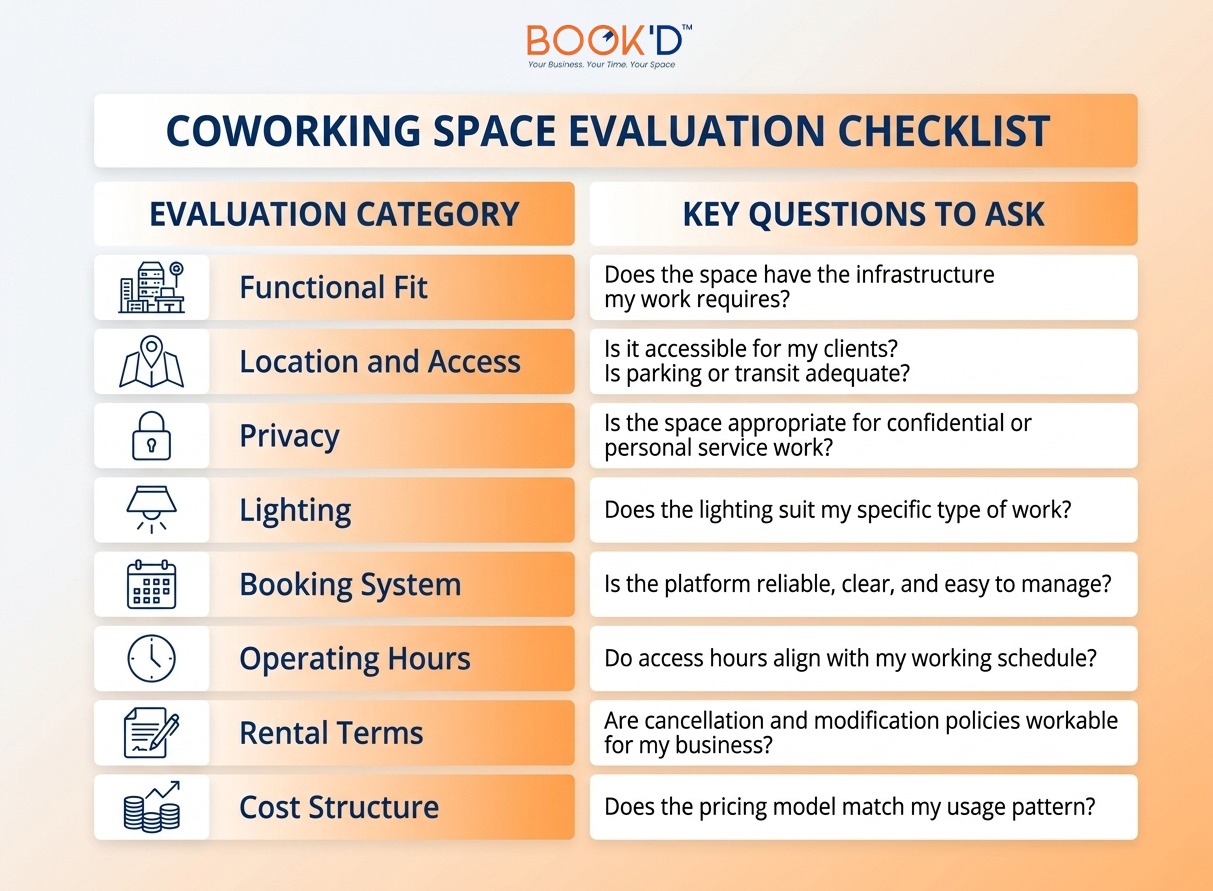
Working through this framework for each space you seriously consider takes maybe twenty minutes and saves considerably more than that in wasted bookings and avoidable frustrations.
FAQs
What should I look for when renting a workspace?
When choosing workspace rental, prioritize functional fit above all else. The space needs to have the specific infrastructure your work requires, whether that’s plumbing, acoustic treatment, appropriate lighting, or client-facing privacy. Location accessibility for your clients, operational hour alignment, platform reliability, and clear rental terms are the other critical factors. Leading with price rather than fit is the most common and costly mistake in workspace rental decisions.
How do I know if a rental space is right for my business?
A rental space is right for your business when it supports the quality of work you want to deliver and the client experience you want to create, at a cost structure your current revenue can sustain. Visit the space in person before committing, test any infrastructure critical to your work, and walk the client arrival experience to assess it from their perspective. If the space requires significant workarounds to function for your type of work, it’s not the right space, regardless of how attractive other features are.
What is typically included in a workspace rental?
Inclusions vary significantly by space type and platform. Basic hourly rentals typically include the space itself, standard utilities, and shared amenities like waiting areas or bathrooms. More comprehensive arrangements may include furniture, equipment, Wi-Fi, cleaning between sessions, and booking management tools. Always confirm exactly what’s included before booking, particularly for specialized equipment or amenities that your work depends on.
Is it better to rent a workspace by the hour or with a longer commitment?
For most early-stage and variable-volume professionals, hourly or weekly rental is more financially sound than longer commitments. The flexibility to scale usage up or down with income variability outweighs the marginal cost savings of longer-term arrangements when your business is still building. Move to longer commitments when your client volume is consistent enough that the space will be reliably occupied and the fixed cost is clearly covered by expected revenue.
What are the most common mistakes people make when renting a workspace?
The most common mistakes are leading with price rather than functional fit, failing to visit the space before booking, overlooking operational hour limitations, not reading cancellation and modification terms carefully, and choosing a location that’s convenient for the renter rather than accessible for the client. A clear workspace rental checklist completed before evaluating options prevents most of these mistakes by keeping evaluation criteria objective rather than impression-driven.