


Running a fitness studio looks different from the outside than it feels from the inside. From the outside, it’s classes, community, people showing up and working hard and leaving feeling better than when they arrived. From the inside, it’s all of that plus a constant undercurrent of logistics that never fully quiets down.
Who’s in Thursday’s 6 am class? Whether the Saturday HIIT session is full or has spots. Which members haven’t been in for three weeks? Who cancelled at the last minute, and whether the waitlist got notified. Whether the new instructor’s availability has been updated everywhere it needs to be updated. None of this is the work you got into fitness to do. But all of it has to happen, and when it happens manually, it takes up a disproportionate amount of time and energy that should be going somewhere else.
Booking software for fitness studios exists to take that operational weight off your plate entirely. Not some of it. Most of it. And for studios where class capacity, instructor scheduling, membership management, and client retention all happen simultaneously, the difference between running it manually and running it through a proper system is significant in ways that show up every single week.
The Specific Ways Manual Management Costs Fitness Studios
The cost of managing a fitness studio manually doesn’t show up on a single invoice. It shows up across a dozen small inefficiencies that compound into something significant over time.
Classes that fill up without a waitlist system capturing interested members. Cancellations that come in without automatic notification go to the next person in line. Instructors schedule changes that get communicated through a chain of messages instead of updating automatically everywhere that matters. Membership renewals that slip through because nobody had a system to flag them. New members who had a confusing first booking experience quietly chose a different studio instead.
Each of these individually is manageable. Together, they represent a meaningful amount of lost revenue and lost retention that a fitness class booking software system eliminates without requiring anyone to actively manage it.
The no-show problem deserves specific attention because it hits fitness studios particularly hard. A yoga class with twelve spots that gets three no-shows without warning isn’t just a disappointment. Its capacity could have served three paying members who were sitting on a waitlist. Automated reminders and waitlist management working together solve this problem completely.
What Changes When You Have the Right System
Class Management That Runs Itself
The most immediate change when a fitness studio implements proper gym scheduling software is that class management stops being a daily manual task. Classes publish, fill, maintain waitlists, send reminders, and update in real time across every channel without anyone coordinating it.
A member books a spot, receives confirmation immediately, gets a reminder the day before, and if they cancel, the next person on the waitlist gets notified automatically. Nobody at the studio touched any of that. It just happened the way it was supposed to.
For studios managing multiple class types, multiple instructors, and multiple time slots across a week, this automation isn’t just convenient. It’s the difference between a schedule that runs smoothly and one that requires constant manual intervention to prevent it from falling apart.
Instructor Scheduling Without the Back and Forth
Coordinating instructor availability manually is one of the more time-consuming administrative tasks in a fitness studio. Availability changes, substitutes need to be arranged, and the schedule needs to reflect all of it accurately everywhere clients look.
A proper fitness appointment booking system centralises instructor availability and propagates changes automatically. When an instructor updates their availability, it reflects immediately in the booking system. When a class needs a substitute, the system supports that process rather than requiring a separate chain of communication to manage it.
For studios operating out of a studio space for rent arrangement where multiple instructors share space on different schedules, this centralised visibility is particularly valuable. The system knows who’s using the space when, and clients see accurate availability without anyone manually reconciling multiple schedules.
Member Experience That Actually Retains People
The booking experience a member has with your studio is part of their experience of your studio. A clunky booking process that requires too many steps, doesn’t work properly on a phone, or takes too long to confirm creates friction before a class has even started.
Good fitness class booking software makes the member-facing experience feel effortless. They find a class, see real availability, book in seconds, receive confirmation, and get reminded before they need to show up. Nothing to second-guess. Nothing to struggle with. That frictionless experience contributes to retention in ways that are hard to measure directly but consistently show up in the studios that prioritise it.
How Different Fitness Studio Types Benefit
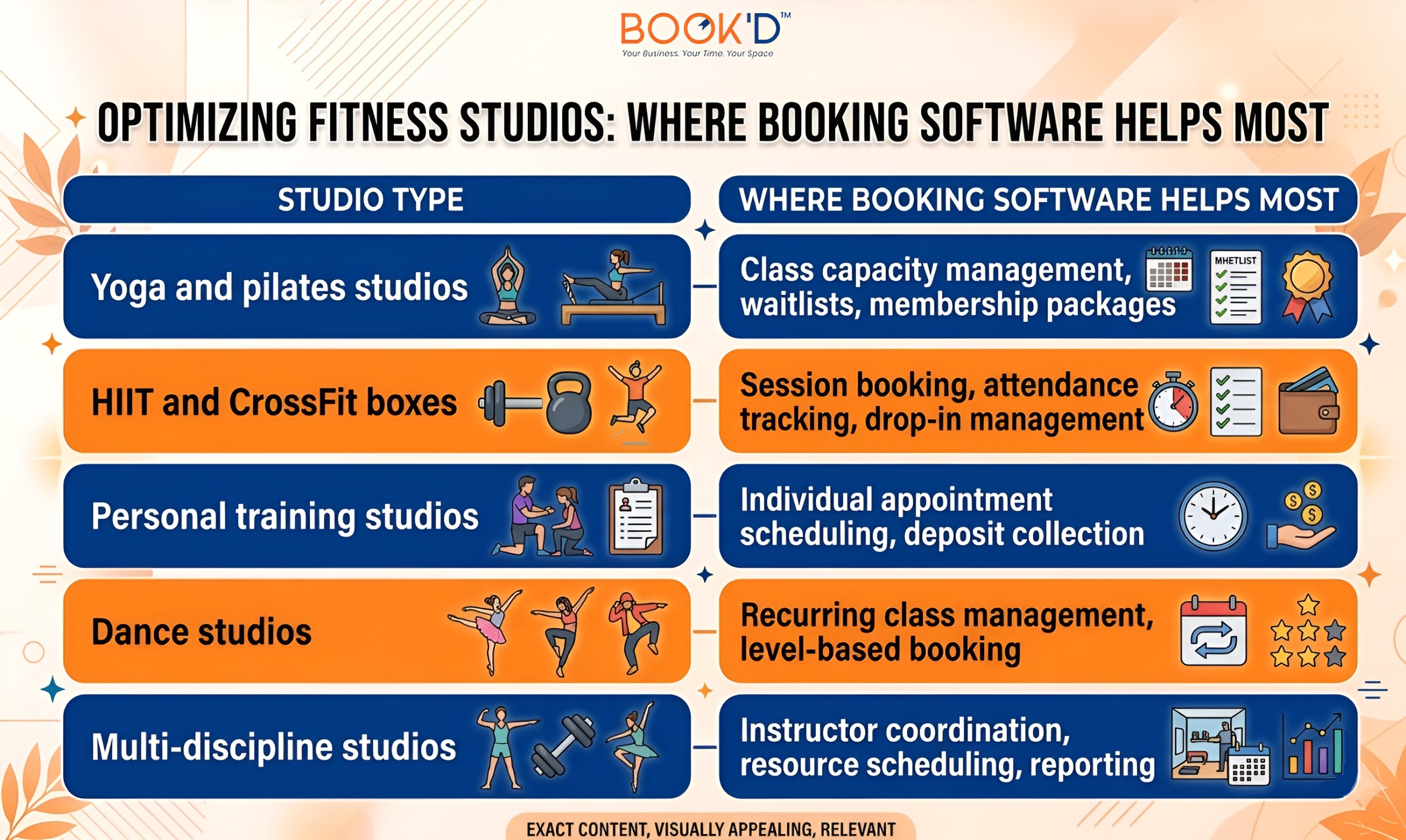 The platform that works for a large multidisciplinary studio with fifteen instructors isn’t necessarily the right fit for a personal training operation running out of an hourly studio rental. Understanding what your specific setup needs before evaluating any platform is the most useful thing you can do before committing to anything.
If you want to see how booking software applies across different types of service businesses beyond fitness, this blog on booking software helps salon businesses cover the parallel experience in the beauty and wellness space in ways that are directly relevant to fitness studio owners, thinking through the same decisions.
The Features That Matter Most for Fitness Studios
Waitlist Management That Actually Works
A waitlist that notifies members automatically when a spot opens is one of the highest-value features a fitness studio can have. It fills cancelled spots without anyone doing anything. It captures demand that would otherwise be lost. And it gives members a reason to stay engaged with your schedule even when classes are full.
Manual waitlist management, where someone has to notice a cancellation and reach out to the next person in time, is how studios lose the members who were most motivated to attend.
Membership and Package Tracking
Fitness studios often sell access in packages. Ten class packs, monthly memberships, unlimited passes. Tracking which members have how many classes remaining, when memberships expire, and who needs to renew is exactly the kind of ongoing administrative task that a booking system handles automatically and that manual management handles inconsistently at best.
Attendance and Retention Reporting
Knowing which classes fill consistently and which don’t. Knowing which members haven’t been in for a month. Knowing what your busiest times are and what’s consistently underperforming. This data exists in every fitness studio’s booking history, and a proper system surfaces it without requiring anyone to build a spreadsheet to find it.
Cancellation Policies That Enforce Themselves
A late cancellation policy that applies only when someone notices and decides to say something isn’t really a policy. Booking software enforces the window automatically. The member tries to cancel inside it, and the system handles the consequence without the studio having to initiate anything. Consistent enforcement makes the policy real, and members respect it accordingly.
What to Look For Before You Commit
Not all booking software is designed with fitness studios specifically in mind, and some platforms that work well for appointment-based businesses struggle with the class-based, capacity-managed, waitlist-driven model that most fitness studios run on.
The most important evaluation step is running through the member booking experience yourself as if you were a new member who’d never seen the studio before. If anything feels slow, confusing, or like one step too many, your members will feel it too, and some of them will give up before finishing.
Fitness studios run on energy, community, and showing up consistently. The administrative systems surrounding all of that should support the work rather than compete with it for your attention. That’s the problem Just-Booked is built to solve for every fitness studio owner who’s done managing it manually.
FAQs
Why do fitness studios need booking software?
Fitness studios run on class capacity, waitlists, instructor schedules, membership tracking, and attendance management simultaneously. Managing all of this manually creates inefficiencies that cost studios revenue and retention over time. Booking software for fitness studios automates these processes, fills classes more efficiently, reduces no-shows through automated reminders, and gives studio owners accurate data to make better decisions about their schedule and offerings.
What features should fitness studio booking software have?
Class capacity management, automated waitlists, instructor scheduling, membership and package tracking, automated reminders, attendance reporting, and cancellation policy enforcement are the features that deliver the most practical day-to-day value. How well the platform handles your specific class structure and membership model should be tested during a trial period before committing.
How does booking software reduce no-shows for fitness classes?
Through automated reminders sent at timed intervals before each class and through waitlist management that fills cancelled spots automatically. Most no-shows in fitness settings happen because members forget, particularly for classes booked days in advance. A reminder the day before and another a few hours out keeps the commitment present. Pairing this with a cancellation policy that’s automatically enforced adds a further layer of accountability.
Can booking software handle multiple instructors and class types?
Yes, and for studios with complex schedules involving multiple instructors and class formats, this is one of the most valuable capabilities. Look specifically for platforms that manage instructor availability at the individual level and reflect changes automatically across the booking system. Test your exact schedule configuration during a trial period rather than assuming the platform handles it the way you need it to.
Is fitness studio booking software worth the monthly cost?
For most studios, yes, usually significantly. Filling two or three extra spots per week that would have been lost without waitlist automation typically covers the cost of most subscriptions. The time saved on manual schedule management, membership tracking, and reminder sending adds up substantially across a month. And the improvement in member experience, particularly for new members encountering your booking system for the first time, influences retention in ways that compound over time.