


Every stylist asks themselves: should I work with someone else or rent my own space? Not a simple choice. Which direction you take affects your salary, schedule, and creative freedom.
The truth is, it depends. But that’s not helpful alone. Let’s simplify so you can decide, not just be confused.
Salon space rental, what does that mean?
A chair, suite, or specialised location in a salon is rented for a certain price. You’re not employed. You choose your hours, grow your customer list, and keep your revenues minus the rental charge and product costs.
The Real Benefits of Renting Salon Space
This is where things get genuinely interesting. The benefits of renting salon space go beyond just “being your own boss.” For a lot of stylists, it’s the first time their income actually reflects the quality of their work.
When you’re employed in a salon, there’s usually a commission split or a flat hourly rate. You could be fully booked for six straight hours and still take home a fraction of what you brought in. Renting flips that. You pay your space fee and everything above that is yours.
Here’s what most renters point to as the biggest wins:
- Pricing freedom: Based on experience and market, you decide service charges.
- Schedule control: Work mornings, nights, weekends, or whenever suits you.
- Client ownership: Your clients follow you, not the salon.
- Independent creativity: Pick your items, music, style, and vibe.
- Growth potential: Building increases earnings.
There’s also something less tangible but very real: confidence. Having your name on your space changes how clients see you and how you see yourself.
Renting Salon Space vs Working in a Salon: An Honest Comparison
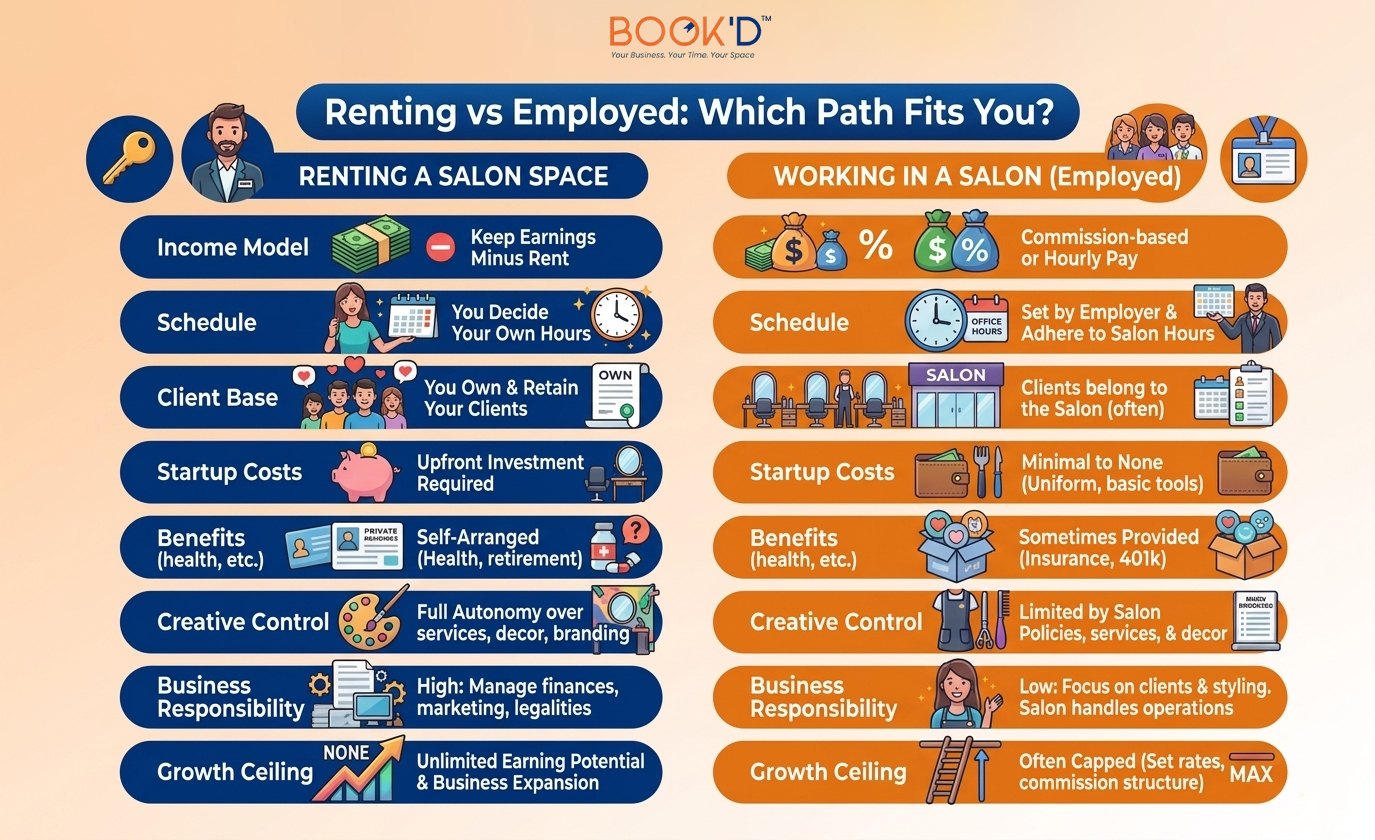 Let’s look at this side by side. The comparison of renting salon space vs working in a salon isn’t about which one is universally better. It’s about which one fits where you are right now.
Neither column is all good or all bad. If you’re early in your career and still building skills, a salaried salon role gives you structure, mentorship, and a financial cushion. If you’ve got a steady client base and you’re leaving money on the table every week, renting starts to look very different.
Speaking of making smart moves in the salon industry, if you’ve ever wondered whether you can start a salon business without actually owning the space outright, we covered exactly that. Our post on start a salon business without owning a salon walks through the realistic routes stylists are using to launch without a massive upfront investment.
Is Salon Booth Rental Worth It?
This is the version of the question people Google at 11pm when they’re weighing a big career decision. And the answer comes down to one thing: your client volume.
If you already have a reliable book of clients who come back consistently, salon booth rental is almost always worth it financially. You stop splitting revenue with someone else and start building something that’s actually yours. The math usually works in your favor once you’re consistently busy.
If you’re still in the growth phase, the fixed rental cost can feel like pressure. That’s not necessarily a bad thing; a lot of stylists say it pushed them to market themselves harder and get serious about building relationships. But it’s worth being realistic about your current numbers before signing anything.
Before you decide between options, it’s also worth understanding the difference between your rental formats. Our breakdown of salon suite vs booth rental covers the pros and cons of each setup so you can choose the structure that actually matches how you work.
Independent Stylist vs Salon Employee: Who Has the Better Career Path?
Honestly, both can lead to a great career. The independent stylist vs salon employee debate has been going on for years, and it’s not going away because there’s no clean winner.
What changes over time is which option gives you more. Early on, a salon job gives you training, exposure to different clients, and a safety net. Later, staying employed can mean leaving serious money and creative satisfaction on the table.
Most stylists who rent say they wish they’d made the move sooner. But they also say they needed their employed years to build the skills and client trust that made renting viable. The two stages aren’t opposites. They’re often a sequence.
If you’re starting to feel like you’ve outgrown your current setup, that’s a signal worth listening to. Just-Booked helps independent stylists find flexible salon spaces without the headache of long-term contracts or confusing terms.
What Happens to Your Income When You Rent?
Your income gets more variable, at first. That’s the honest truth. Some weeks you’ll earn significantly more than you did as an employee. Some slower weeks, especially early on, the gap might feel closer.
What changes over time is the ceiling. As an employee, your income is usually capped, whether by commission structure, your employer’s pricing, or how many clients the salon assigns to you. When you rent, the ceiling essentially disappears. You raise your prices as your reputation grows. You add services. You choose higher-value clients.
The stylists who thrive as renters tend to be proactive about marketing themselves, consistent with their client communication, and intentional about filling their books. It’s not passive. But the payoff compounds in a way that employment rarely does.
If you want to go in with a clear picture of what to expect financially, our guide on how much does it cost to rent a salon space? breaks down what factors drive pricing and how to budget before you commit.
Things to Think Through Before Making the Switch
Switching from employed to renter isn’t just a financial decision. It touches your routine, your relationships with colleagues, and your sense of identity at work. A few things worth sitting with before you decide:
- Do you have enough regular customers to cover rent?
- Can you do your own taxes and bookkeeping?
- Do you appreciate company management or find it draining?
- Are your clients able to reach the salon?
- The lease or rental agreement says what?
That last point matters more than people realize. The terms of your rental agreement shape everything from how much control you have over your space to what happens if you need to leave early. We put together a detailed guide on what to check before renting a salon space worth reading before you sign anything.
Conclusion
No version of this decision is risk-free. Working in a salon has its own risks, income limits, job security, and lack of control. Renting has different ones, slower starts, self-employment pressure, and fixed costs before you’ve built momentum.
But for stylists who are ready, the benefits of renting salon space are genuinely hard to argue with. More income, more freedom, more ownership over the career you’ve worked to build. Private salon suites exist to make that transition easier by connecting independent stylists with spaces that actually work for the way they want to operate.
The question isn’t really whether renting is better. It’s whether you’re ready for what comes with it.
FAQs
What is the difference between renting a salon and working there?
A salon worker gets paid a specific amount or a commission to follow the salon’s rules and schedule. You work as an independent professional after paying your salon lease fee. You set your own hours and pricing, and you retain all the money you make. Taking charge of your time, prices, and connections with clients is what makes the difference.
Who should rent a salon booth?
Stylists who have a constant stream of clients and are good at handling bookings and budgets can rent a salon booth. This is also a fantastic choice for someone who has hit the maximum amount they can make at their current job and wants to have more control over their money.
How can I tell whether I’m ready to rent instead of work?
When client demand is higher than what you have put up, that’s a good sign. Renting may be the next step if you can’t take on new clients, you’re booked weeks in advance, or you’re unhappy with how commission splits or scheduling work.
Does hiring a salon facility imply you won’t get any walk-in clients?
Not always. Rental salons may still feature a front-of-house approach that lets people walk in. Most renters depend on their own marketing and their current clients. That base helps the model survive longer.
What should I think about while deciding between renting a salon space and working at a salon?
Think about how much money you make now compared to how much you could make, how much you own your client base, how much you value creative and schedule autonomy, and whether you feel comfortable being self-employed. Honestly, comparing such things usually gives you a clear answer.