


Let’s be honest for a second. The old dream of owning a salon usually came with a nightmare of debt. You pictured having your own key, your own shampoo station, and absolute control over the playlist. But then you saw the lease agreement. The build out costs. The utilities. The drama of managing other stylists’ schedules.
It’s exhausting just thinking about it.
Here is the good news: You don’t need to sign a ten year lease to build a six figure beauty business. In fact, some of the most profitable stylists and estheticians are walking away from traditional ownership entirely. They have figured out how to run a salon business without a shop, and they are keeping more of their hard earned money because of it.
So, can you start a salon business without owning a physical storefront? Absolutely. But let’s dig into how this actually works in the real world, not just in a motivational quote.
The Shift: Why Renting a Chair Beats Owning Four Walls
For decades, the hierarchy was simple. You assisted, you rented a chair, you managed a room, and eventually you opened a “real” salon. But that ladder is broken for a lot of people. The pandemic taught us that clients will follow talent, not a building.
If you want to know whether you can Start a Salon Business Without Owning a Salon?, you need to change your definition of “ownership.” You aren’t owning real estate. You are owning a brand, a client list, and a reputation.
Instead of paying for a vacant lobby at 8 AM, you pay for time. This is where the concept of hourly studio rental changes the math. You only pay for the space when you are actively making money. That is a massive shift in cash flow.
Think about the numbers for a second. A traditional salon owner pays rent 24/7. You pay for Monday morning when you are closed. You pay for Tuesday night when you are at home. With a flexible model, your overhead sleeps when you do.
Can You Start Without Renting Space? (The Hybrid Model)
This is the question that trips everyone up. Can you start a salon without renting space? Technically, yes. Legally, it depends on your state board regulations.
Many successful hairstylists begin with “mobile pop-ups.” You go to the client’s home for a blowout or a bridal trial. However, this is hard on your body and your equipment. Dragging a chair up three flights of stairs gets old fast.
The smarter transition is the “micro suite.” You don’t have to rent a whole salon. You just need one room. Look for private salon suites that offer month-to-month terms. This gives you a mailing address and a professional backdrop for social media without the headache of fixing a leaky faucet.
Here is where you find your freedom. If you are tired of lugging your kit around or dealing with house call cancellations, rent a salon chair in a shared, high-traffic space. It gives you instant legitimacy and walk-in traffic without the management duties.
The Practical Guide: How to Become a Hairstylist Without Owning a Shop
We need to talk about your mindset. Early on, you might feel like a “fraud” if you don’t have your own four walls. That is just impostor syndrome. Clients don’t care who owns the building. They care if their roots are done correctly.
Here is how to build authority while being a renter.
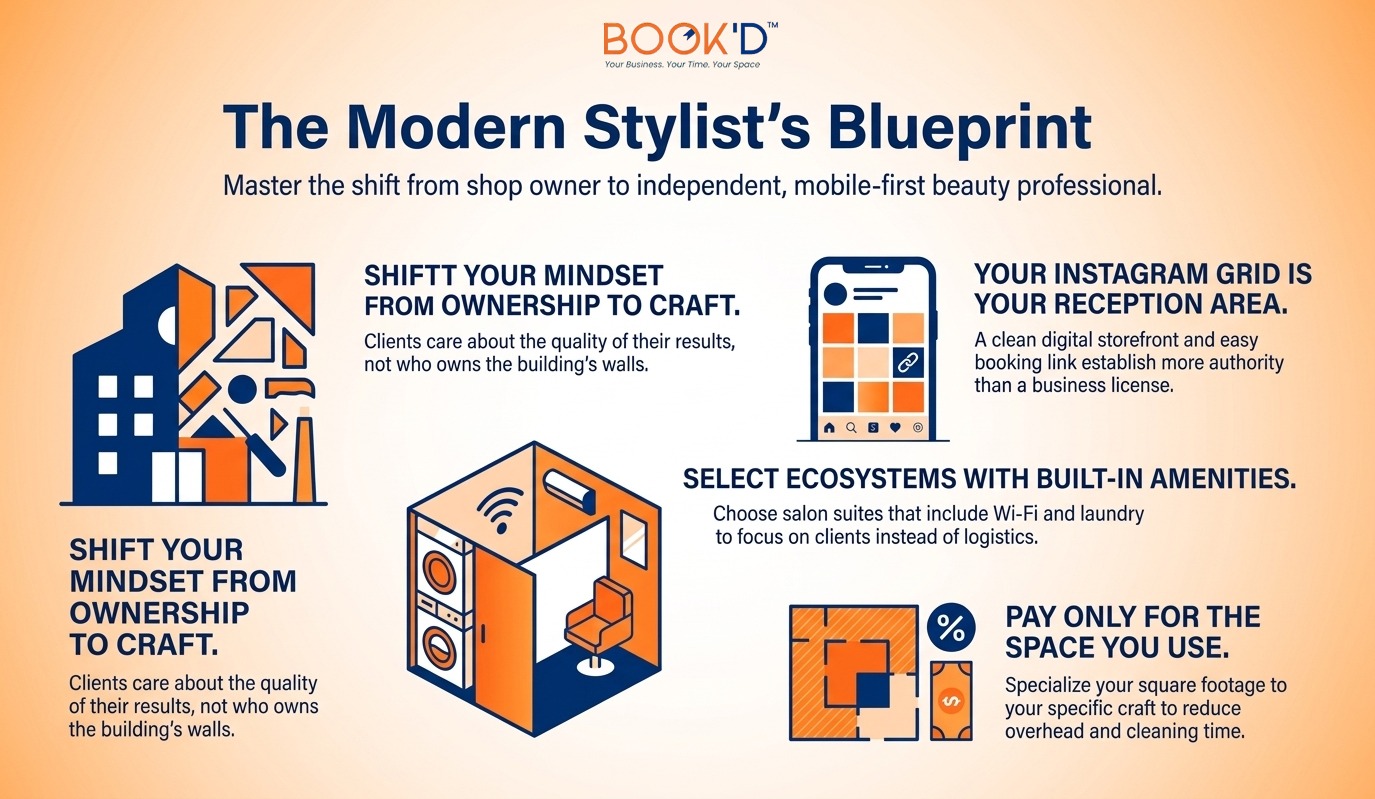 1. Build your digital storefront first.
Your Instagram grid is your new reception area. If your photos are clean and your booking link is easy to find, no one asks to see your business license.
2. Find the right ecosystem.
You want to look for spaces that offer salon suites for rent Chicago (or your local market) that include Wi Fi and laundry. You want to focus on your craft, not logistics.
3. Specialize your space.
If you are a lash artist, you don’t need a barber chair. You need a comfortable bed and good lighting. Searching for a lash room for rent is much cheaper than renting a full salon. You pay for the square footage you actually use, not the square footage you have to clean.
The Hidden Perk: Community vs. Isolation
One fear that stops people from learning how to run a salon business without a shop is loneliness. When you work alone, you miss the banter of the breakroom.
However, renting a suite inside a larger collective solves this. You get a lock on your door for privacy with your client, but you share a hallway with a barber and a brow tech. You can cross refer clients. You can borrow a bottle of hairspray in an emergency.
But what if you want zero interaction? That is fine too. Look for studio space for rent that operates on a key code entry system. You come in, work your magic, and leave. No small talk with the receptionist required.
Want to see what your business could look like without the stress of a lease? Check out the flexible options available at Just-Booked. You might be surprised how affordable it is to start.
Is This Model Right for You?
This isn’t for everyone. If you hate packing up your supplies or if you need a “home base” to feel secure, a traditional suite might still be your goal. But for the modern beauty entrepreneur, flexibility is currency.
You can test a new service without renovating a room. You can raise your prices because your overhead is fixed and low. You can take a vacation without paying for an empty storefront.
We see professionals transition from commission employees to six figure independent renters every single day. The barrier to entry is lower than ever. You just have to stop waiting for the “perfect” building to appear.
FAQs
How to run a salon business without a shop legally?
You need a business license and liability insurance, but you do not need a commercial real estate lease. You operate as a mobile stylist or rent a booth/suite. Check your state’s cosmetology board to ensure the rental space meets sanitation codes.
Is it cheaper to rent a barber chair or own a salon?
Renting a chair is significantly cheaper. Ownership includes triple net leases, repair costs, and utility deposits. A barber chair for rent typically costs a fixed weekly or daily rate, allowing you to write off 100% of that expense as an operating cost rather than a capital investment.
Can you start a salon business without owning a salon if you do house calls?
Yes, but logistics matter. House calls offer low startup costs but high travel time. You can mix house calls with a salon booth rental for two days a week to handle chemical services that require proper ventilation, which a client’s home may lack.
What is the difference between a studio suite and a booth rental?
A booth rental is usually an open floor plan with other stylists. A private salon suite is a lockable, private room. Suites are better for estheticians or lash artists who need privacy for draping clients, while booth rentals are better for haircutters who thrive on walk in energy.
Do I need to buy my own insurance for private salon suites?
Yes. The suite landlord covers building insurance, but you need professional liability (malpractice) and product liability. Never rely on a landlord’s policy. If you spill color on the carpet, their insurance won’t cover your mistake. Your own policy costs roughly $30 to $50 a month.