


A talented stylist or esthetician can build a loyal following in a mediocre space. That much is true. But they’ll work twice as hard to do it, lose clients they shouldn’t have lost, and wake up one day exhausted by how much effort it takes to keep a chair filled in a location that quietly fights against them every single day.
The conversation around salon location importance tends to stop at foot traffic. Is the street busy? Are there shops nearby? That’s the surface-level stuff. The real impact runs deeper. Location shapes how clients feel about the appointment before they’ve even walked through the door. It determines whether they rebook without hesitation or hesitate for three days and then forget. It influences the kind of client you attract, what they’re willing to pay, and whether they become a regular or a one-time visitor who appreciated your work but quietly decided the journey wasn’t worth repeating.
This blog digs into what beauty business location tips actually matter, not the generic advice about busy streets, but the specific ways your workspace location interacts with client psychology, booking patterns, and long-term retention.
The Psychology of the Journey
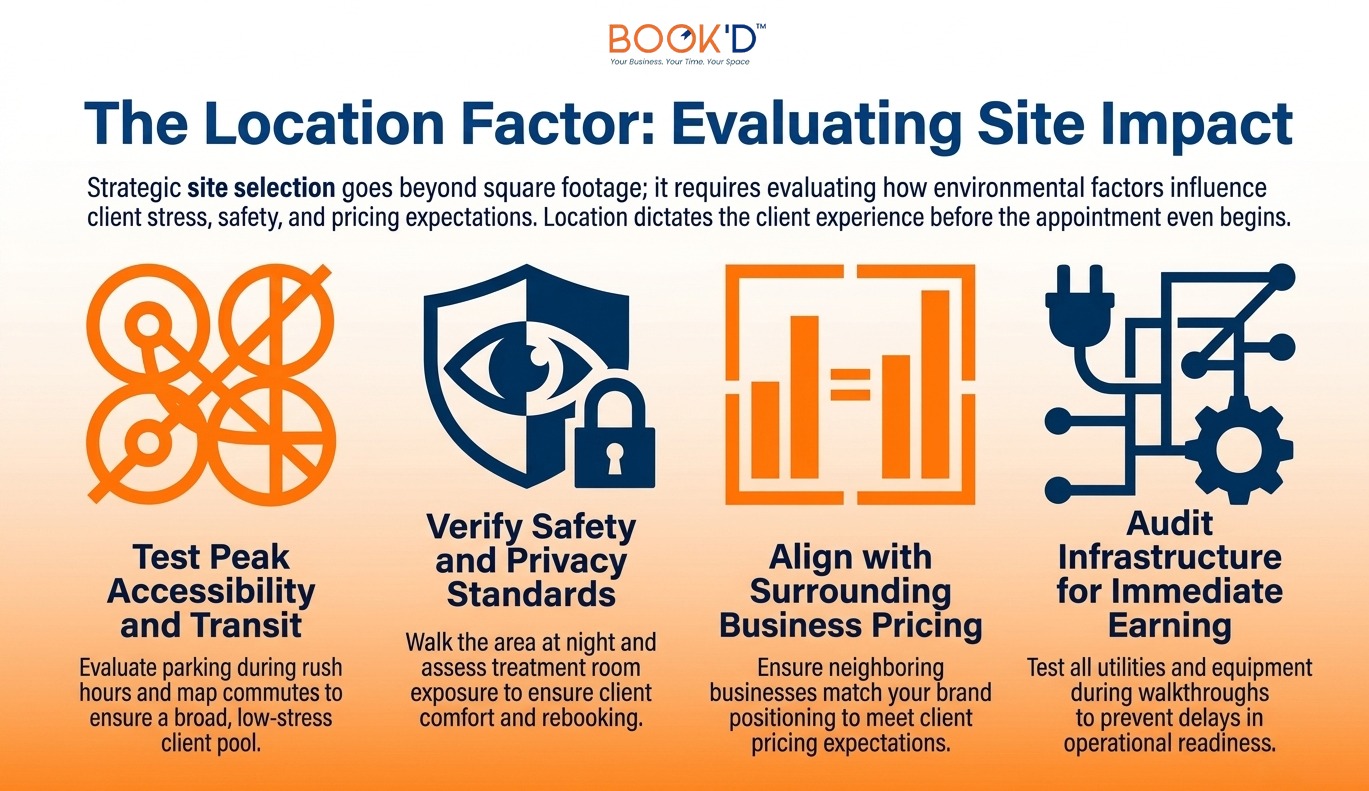
Client booking behavior isn’t just about whether someone liked your work. It’s about the entire experience surrounding the appointment, and that experience begins the moment they leave their house. If the journey is stressful, the service starts at a deficit. The client arrives already slightly drained, and your work has to overcome that before it can even begin to impress.
Consider the difference between two identical services delivered by the same skilled professional. In one scenario, the client drives ten minutes, parks easily right outside, and walks into a space that feels calm from the moment they enter. In the other, they circle for parking, feed a meter, walk past construction, and arrive flustered.
Same service. Same professional. Radically different emotional starting point. The second client might still enjoy the service, but their memory of the experience is colored by the frustration that bookended it. When they’re deciding whether to rebook next month, that feeling lingers in the background.
Convenience Is a Retention Strategy
There is a reason clients drift away from talented professionals, and it has nothing to do with the quality of the work. The location simply wore them down over time. Maybe parking was always a little tight. Maybe the neighborhood felt sketchy after dark when their evening appointments ended. Maybe public transit required a transfer that added thirty minutes to their trip. None of this felt like a dealbreaker on the first visit. But by the fourth or fifth, the friction accumulated.
Understanding client booking behavior means accepting that people make rebooking decisions partly based on emotional math that they rarely articulate. They won’t tell you the location is the problem because they might not even consciously identify it. They’ll just say they got busy, or they’ll try someone closer to their office, or they’ll stop booking entirely, and you’ll wonder what went wrong.
This guide on lash artist client growth explores how retention depends on the full client experience, arrival, environment, service, departure, and location, which is the bookend that holds the whole thing together.
Who Finds You and Why It Matters
The Local Discovery Engine
When someone searches for a service you provide, their search behavior tells you something about their expectations. A person typing “lash extensions near me” is behaving differently from someone searching for “best lash artist in the city.” The first person prioritizes proximity. The second prioritizes reputation but is likely willing to travel.
Your location determines which of these clients finds you, and that shapes your entire business. A professional in a densely residential area surrounded by young professionals will attract a different clientele than one in a luxury retail district near high-end boutiques. Neither is wrong. But if your pricing, service style, and client experience don’t align with the expectations your location sets, the mismatch creates friction that depresses bookings.
This is where local service SEO becomes relevant in ways that go beyond search rankings. It’s not just about appearing in local results. It’s about what happens when someone clicks through, sees your address, and makes an immediate, subconscious judgment about whether your location matches their expectations for the service and price point.
The Neighborhood Sets a Price Ceiling
A neighborhood communicates value before you say a word about your pricing. If clients associate the area with premium experiences, they arrive expecting premium pricing and judge your services accordingly. If the area reads as budget-conscious, even exceptional work faces upward pressure on price resistance.
This doesn’t mean you need the most expensive address in the city. But it does mean the neighborhood should align with the clientele you’re trying to attract. A mismatch forces you to constantly justify your worth against the backdrop of an environment that subtly undermines it.
When Privacy Becomes a Priority
Certain beauty services require a specific kind of environment to feel worth the price clients are paying. Lash extensions, advanced esthetics, and intimate waxing services aren’t quick transactions. They’re extended appointments during which the client is vulnerable, eyes closed, body exposed, trusting the professional completely.
A location in a high-traffic open-plan salon where strangers wander past the treatment bed while the client is mid-service doesn’t support that vulnerability. It cheapens it. Clients may not complain directly. They’ll just book once and never return, or they’ll choose a competitor who offers the privacy they didn’t realize they needed until they experienced its absence.
This guide on private salon workspace explains why demand for enclosed, private rooms has accelerated so dramatically. It’s not a trend. It’s clients voting with their bookings for environments that honor the intimacy of the services they’re receiving. For professionals booking a salon space for rent, the level of seclusion that the space provides directly impacts how clients perceive the value of the treatment and whether they’ll return.
The Equipment That Grounds a Location
Even the best-located space falls apart if the infrastructure doesn’t support the work. A stylist who needs a hydraulic chair and proper plumbing for color services can’t function in a room built for dry treatments. An esthetician who needs a sink for product removal and proper ventilation for chemical peels will struggle in a room designed for something else entirely.
When evaluating a location, the equipment isn’t a secondary consideration. It’s the thing that determines whether the space is actually usable for your specific services. Renting a salon chair for rent in a space that already has professional-grade stations, proper lighting, and adequate power means you can start working immediately without retrofitting anything.
That convenience isn’t trivial. It’s the difference between opening your book immediately and spending weeks or months getting the space functional while your clients wait.
How Location Factors Affect Client Decisions
The Space That Keeps Your Book Full
There is a version of this business where you spend years fighting your location, constantly marketing to overcome the friction it creates, replacing the clients who quietly drift away from the inconvenience, and wondering why growth feels so much harder than it should.
Then there is the version where your location does part of the work for you. Clients arrive calm. They find parking easily. The neighborhood reinforces your pricing rather than undermining it. The privacy level matches the intimacy of the service. Rebooking feels natural because nothing about the experience was a hassle. That version of the business requires the same skill and effort from you, but the location amplifies your results instead of muting them.
The decision to rent a space is significant, but so is the cost of staying in one that doesn’t fit. This guide on salon rental mistakes walks through the common errors professionals make when choosing a workspace, and location misjudgment sits near the top of that list every time. Pair that awareness with this guide on esthetician income tips, which covers how the right workspace environment directly supports higher revenue and steadier bookings, and the picture becomes clear. The space you choose isn’t just overhead. It’s the stage your entire business performs on.
We exist because too many talented professionals settle for spaces that don’t support their work. The platform makes it possible to find and book a workspace that matches your services, your clientele, and the experience you’re trying to deliver, without locking yourself into something that outlasts its usefulness.
FAQs
Why does salon location matter for client bookings?
Salon location matters because it shapes the entire client experience beyond the service itself. A location that is difficult to reach, has limited parking, or feels unsafe creates friction that discourages rebooking even when the service quality is high. Clients make repeat booking decisions partly based on convenience, and a location that consistently frustrates them will lose them to closer or more accessible alternatives over time.
How does salon location affect pricing and client perception?
A neighborhood communicates value before any service is delivered. Clients form immediate expectations about pricing and quality based on the surrounding businesses, the condition of the building, and the overall feel of the area. A location that aligns with your pricing and service style reinforces your value. A mismatch forces constant justification and can create price resistance even when your work is exceptional.
What should I look for in a salon location before signing a lease?
Visit the location at the times your appointments actually run. Test parking, transit access, and how the neighborhood feels after dark. Evaluate whether the infrastructure supports your specific services, plumbing for color work, proper ventilation for chemical treatments, and adequate power for equipment. Walk the client arrival experience from the street to the treatment area and ask whether it feels like the beginning of a premium service or an obstacle course.
Can I succeed in a less visible salon location?
Yes, but success in a less visible location depends more heavily on strong local SEO, word of mouth, and social proof. A tucked-away space can work well if your clientele values privacy and intimacy, particularly for services like lash extensions and advanced esthetics. The key is making the arrival experience feel intentional rather than hidden, with clear directions, good lighting, and a space that feels worth finding.
How does salon location influence client retention long-term?
Over time, a convenient, pleasant location becomes part of the client’s routine rather than a recurring hurdle. The appointment feels easy to keep, which reduces cancellations and no-shows. A frustrating location has the opposite effect; each visit requires overcoming resistance, and eventually the client seeks an alternative that fits more seamlessly into their life. Retention is rarely lost in a single bad experience. It erodes appointment by appointment when the location consistently asks more of the client than they’re willing to give.