


There’s a ceiling that many estheticians hit, and it’s not because their skills aren’t good enough.
The work is strong. Clients are happy. Re-bookings are consistent. But the income stays frustratingly flat, and the path to earning more feels like it requires either working more hours than are sustainable or making some kind of major leap into owning a full salon, which comes with overhead, risk, and complexity that most independent practitioners aren’t ready to take on.
What gets missed in that framing is the third option. The one that’s sitting squarely between “stay exactly where you are” and “sign a commercial lease and hire staff.” It involves thinking more strategically about how workspace, pricing, and service structure work together, and it’s where the most practical esthetician income tips tend to live.
This blog is for the esthetician who is serious about growing revenue without burning out or overcommitting financially. It covers the workspace decisions, pricing approaches, and business habits that actually move the needle for independent skincare professionals.
Why the Workspace Decision Affects More Than Just Overhead
Most estheticians think about their workspace primarily in terms of cost. How much does it run per month? Does the math work relative to what I’m currently bringing in? Those are reasonable questions, but they’re incomplete ones.
The workspace decision affects client perception, service capacity, pricing power, and the overall trajectory of the business in ways that go well beyond the monthly rental figure. A professional, private, well-equipped space communicates something to clients that a shared or improvised setup simply cannot. It signals that you’re running a real business, that the experience will be consistent and intentional, and that the investment they’re making in their skin is being taken seriously on your end, too.
That perception shift directly affects what clients are willing to pay. Beauty service pricing is not purely a function of market rates. It’s also a function of perceived value, and perceived value is heavily influenced by the environment in which the service is delivered. An esthetician working from a dedicated, private salon suite can credibly charge more than the same esthetician working from a shared backroom, even if the technical skill is identical.
This is the foundational logic behind why so many independent skincare professionals who are serious about skincare business growth make the workspace upgrade before they feel financially comfortable doing so. The upgrade enables the pricing adjustment that makes it more than financially viable.
Flexible Workspace Models That Actually Work for Estheticians
The beauty industry has shifted meaningfully in the last several years toward rental models that give independent professionals real options. Understanding those options clearly makes it easier to choose the one that fits where your business is right now and where you want it to go.
Hourly or day rental is the most accessible entry point. It’s ideal for estheticians building their client base, testing a new market, or supplementing an existing setup without committing to a full monthly cost. The flexibility is genuine: you pay for what you use, scale up as your books fill, and avoid the fixed overhead that sinks a lot of new beauty businesses before they hit their stride.
Monthly suite rental is the natural next step for estheticians with an established client base who are ready for a permanent, fully private home for their practice. A dedicated esthetician room for rent at a monthly rate gives you full control over your environment, your branding, your hours, and your pricing, without the responsibilities and financial exposure of a traditional salon lease. You’re running your own business inside a professionally managed facility, which is a genuinely favorable structure for most independent practitioners.
Shared suite arrangements split the cost of a private space between two or more practitioners with complementary schedules. Done well, this model produces a professional environment at a fraction of the individual cost and can create a natural referral dynamic between the practitioners sharing the space.
This guide on lash artist client growth covers the workspace-to-clientele relationship in detail from a closely related professional’s perspective, and the principles translate directly to estheticians navigating the same decisions.
Pricing Strategy: Where Most Estheticians Leave Money on the Table
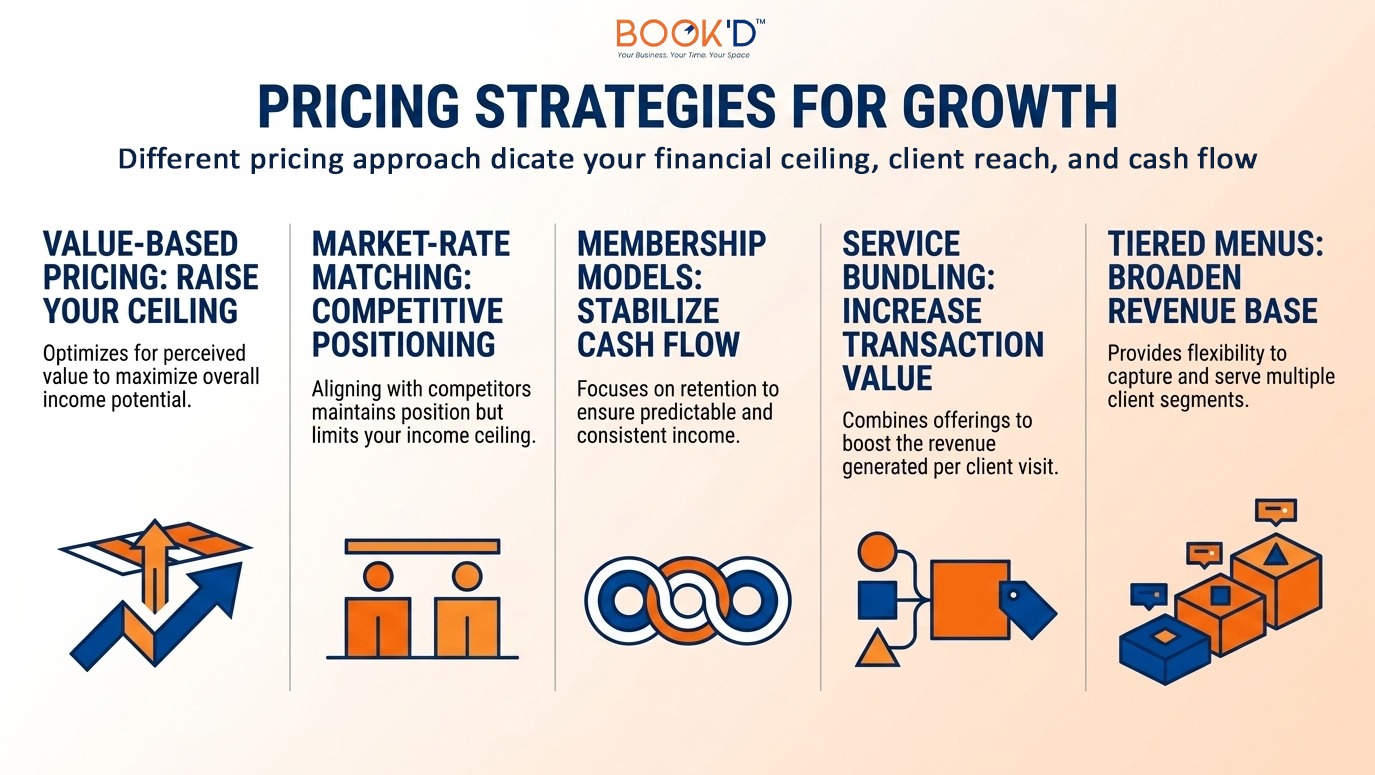 Pricing is the highest-leverage variable in an esthetician’s income equation, and it’s the one most practitioners handle least strategically. The default approach is to look at what comparable services cost in the local market, price at or slightly below that range to stay competitive, and adjust incrementally over time. It’s understandable, and it’s leaving significant money on the table.
Competitive pricing based purely on market rates ignores the most important variable: what your specific clients value and what they’re actually willing to pay for the experience and results you provide. Clients who are committed to their skincare, who rebook consistently, and who refer their friends are not choosing you because you’re slightly cheaper than the esthetician down the street. They’re choosing you because they trust you and value the experience you provide. Your pricing should reflect that.
The practical starting point for better beauty service pricing is a full audit of your current service menu. Which services take the most time relative to what they generate? Which ones produce the best results and generate the most enthusiasm from clients? Which services could be restructured, bundled, or repositioned at a higher price point without meaningful resistance?
Membership and package pricing deserve particular attention because it addresses two income problems simultaneously. It increases average revenue per client, and it stabilizes cash flow by converting variable appointment income into predictable recurring revenue. A simple membership structure offering monthly facials at a discounted package rate, with optional add-ons at full price, can meaningfully change the income consistency of a solo esthetician practice.
Building the Service Menu Around Revenue, Not Just Skills
A lot of estheticians build their service menus around what they’re trained to do rather than what generates the strongest business outcomes. Every treatment on the menu should earn its place not just as a skill the practitioner offers but as a contribution to the overall revenue structure of the business.
High-margin add-on services are one of the most effective esthetician income tips for practitioners who have already optimized their core offerings. LED therapy, dermaplaning, specialty masks, and targeted treatment upgrades can each add meaningful revenue to existing appointments without requiring additional time slots. When offered naturally as part of a consultation rather than as an upsell at the end, they enhance rather than complicate the client experience.
Retail is another revenue stream that many estheticians underutilize. Recommending products is a natural extension of the trust relationship with clients, and clients who buy their skincare from their esthetician are more likely to achieve and maintain the results that keep them rebooking. The income from retail doesn’t replace service revenue, but it builds a meaningful complementary layer that accumulates over time.
For estheticians thinking about longer-term esthetician workspace ideas and how the physical environment can support revenue diversification, this blog on private salon workspace demand explores why dedicated private spaces are increasingly becoming the standard expectation rather than the premium exception.
The Business Habits That Separate Growing Estheticians From Stagnant Ones
Technical skill is the baseline. What separates estheticians whose income grows year over year from those who plateau is a set of business habits that most skincare training programs don’t cover.
Rebooking at every appointment is the single most impactful retention habit an esthetician can build. Not offering to rebook, but actively booking the next appointment before the client leaves. The clients who leave without a scheduled appointment have a much higher drop-off rate than those who leave with one. The friction of rebooking later, even for clients who fully intend to return, causes a surprising amount of revenue loss that compounds significantly over a full year.
Consistent client communication between appointments maintains the relationship and keeps you top of mind at exactly the moments when a client might be thinking about their skin. A brief check-in after a treatment, a skincare tip relevant to the season, or a heads-up about a new service creates touchpoints that feel personal rather than promotional and strengthen the loyalty that drives referrals.
Tracking key numbers gives you the visibility to make good decisions. Revenue per client, average transaction value, rebooking rate, retail attachment rate: these metrics tell you where the business is growing and where the gaps are, with enough specificity to actually act on. Most estheticians running successful independent practices have a clear sense of these numbers, not because they’re analytically inclined by nature, but because knowing them makes the income growth decisions obvious rather than intuitive.
How the Right Workspace Unlocks Everything Else
All of the pricing strategies, service menu optimization, and business habits covered in this blog perform better inside a professional, private workspace than they do in a suboptimal one. The environment is the container for everything else.
An hourly studio rental through a well-run facility gives estheticians at any stage of business development access to that professional environment without the financial commitment of a long-term lease. It’s the infrastructure that makes premium pricing credible, creates the conditions for a genuinely exceptional client experience, and signals to everyone who walks through the door that they’re in the hands of someone who takes their work seriously.
FAQs
How can estheticians increase their income without working more hours?
The most effective ways to increase esthetician income without adding hours are raising prices to reflect delivered value rather than market minimums, adding high-margin service upgrades to existing appointments, introducing membership or package pricing to increase average revenue per client, and building a retail offering that generates income alongside service revenue. Each of these strategies improves the revenue generated per hour rather than simply adding more hours to the schedule.
What is the best workspace setup for an independent esthetician?
The best setup depends on where the business is in its development. Estheticians building their initial client base benefit most from flexible hourly or day rental arrangements that minimize fixed overhead while providing access to a professional environment. Established estheticians with full books typically benefit most from a dedicated monthly suite rental that offers full privacy, branding control, and the consistency clients expect from a premium skincare experience.
How should estheticians price their services?
Estheticians should price based on the value of the experience and results they provide rather than simply matching local market rates. A full audit of the current service menu, identifying which services are underpriced relative to the time and expertise they require, is the practical starting point. Bundled services, tiered menu options, and membership structures can each support higher overall revenue without requiring individual service price increases that feel abrupt to existing clients.
What services make the most money for estheticians?
High-margin add-on services like LED therapy, dermaplaning, and specialty treatment upgrades tend to produce the strongest revenue relative to time because they enhance existing appointments rather than requiring separate bookings. Membership programs generate strong revenue over time because of their recurring nature. Retail recommendations, when built into the natural flow of consultations, create consistent supplementary income that doesn’t require additional appointment time.
Is renting a private suite worth it for an esthetician?
For most estheticians with an established client base, yes. A private suite supports premium pricing, creates a fully controlled client experience, removes the limitations of shared or multi-use spaces, and signals the kind of professionalism that attracts and retains high-value clients. The rental cost is typically offset by the pricing adjustment it enables and the improved retention that comes from a consistently excellent client experience.