

Something has shifted in the beauty industry over the last several years, and you can see it in the kinds of spaces professionals are looking for, the conversations happening in beauty communities, and the steady drop in the traditional open-floor salon as the default setup for independent practitioners.
More beauty professionals want their own space. Not just a station in a shared room or a chair in someone else’s salon, but a genuinely private environment where they control the atmosphere, the booking flow, the client experience, and the look and feel from top to bottom. The demand for private salon workspace isn’t some niche preference anymore. It’s a real movement, and it’s being driven by forces that go way deeper than just wanting more personal space.
This blog explores what’s behind that shift, why it matters for both professionals and clients, and what the rise of independent salon spaces means for the industry going forward.
What’s Driving the Demand for Private Salon Spaces
The Independent Professional Has Changed
The average independent beauty professional in 2026 looks pretty different from their counterpart ten years ago. They’re more likely to have built a personal brand, grown a social media following, developed a specific aesthetic identity, and positioned themselves around a focused service niche instead of a general menu.
That kind of professional identity doesn’t fit comfortably into a shared, open-floor salon environment. When your brand is built on a particular atmosphere, a specific client experience, or a carefully put-together visual identity, working in a space you don’t control becomes a constant battle between the brand you’re building and the environment you’re actually working in.
Beauty workspace trends reflect this tension pretty clearly. The fastest-growing piece of the beauty workspace market isn’t traditional salon suites or booth rentals in shared salons. It’s fully private, independently operated spaces where the professional has real control over every element of the client-facing environment. That control isn’t about being picky. It’s a business asset.
Client Expectations Have Evolved
On the client side, the shift is just as clear. Beauty services have increasingly moved toward the personal and the intimate. A lash appointment, a facial, a hair colour session, a brow treatment, these are services that clients experience in close physical contact with their provider, often involving real conversation, personal sharing, and a level of vulnerability that a busy open-floor salon doesn’t always handle well.
Privacy matters to clients in ways that directly affect their satisfaction, their loyalty, and their willingness to refer their friends. A client who feels genuinely at ease during their appointment, not watched by strangers, not rushed by the energy of a crowded shared space, has a completely different experience than one who feels like part of an assembly line. That difference shows up in rebooking rates, in reviews, and in the word-of-mouth referrals that drive sustainable client growth.
The Professional Case for a Private Salon Workspace
Control Over the Client Experience
The biggest practical advantage of a private salon workspace is being able to design and control the client experience from start to finish. Lighting, music, scent, temperature, how fast the appointment moves, how the conversation flows in a private space, you manage all of these. In a shared space, most of them are decided by someone else or by the collective energy of the room.
That level of control produces real results. Professionals in private spaces consistently report higher client retention, stronger average ticket values, and more consistent five-star reviews compared to their time in shared environments. The link between environment and client satisfaction is direct, and it’s not really surprising when you think about it. Clients pay for an experience, not just a service, and the quality of that experience is heavily shaped by the environment where it happens.
Financial Clarity and Business Independence
Salon privacy benefits go beyond just how things feel. Private spaces create financial clarity that shared arrangements often lack. When you operate in your own space, every booking you fill goes entirely to your business. There’s no commission structure, no house percentage, and no confusion about whose clients are whose. Your book is your book, and the revenue it brings in is unambiguously yours.
This clarity matters for salon financial planning and for the long-term sustainability of an independent beauty practice. Being able to price your services accurately, understand your true cost per appointment, and make smart decisions about capacity and scheduling becomes much more straightforward when you’re operating in a space that’s completely aligned with your own business instead of being inside someone else’s.
Private salon suites have become the practical way to get this kind of independence at a cost that doesn’t require the full financial commitment of leasing and building out a traditional salon. You get the professional environment, the operational independence, and the client experience control, without the overhead exposure that traditional salon ownership brings.
What Types of Private Spaces Are Available
Suite-Based Models
The most established format for private beauty workspace is the salon suite model, individual rooms within a larger facility that are rented to independent professionals on weekly or monthly terms. Each suite is a fully self-contained working environment, usually equipped with the infrastructure needed for the main service type, with shared access to common areas like waiting rooms, laundry facilities, and sometimes reception support.
Salon suites for rent in this format are available across most urban and suburban markets, with how many options you have varying by city. Chicago, for example, has seen a lot of growth in suite availability over the last several years, with salon suites for rent Chicago options now ranging from small boutique independent facilities to larger purpose-built suite complexes in multiple neighbourhoods.
The suite model works well for professionals who want a consistent, dedicated space with a stable home base for their practice. It gives you predictable cost and environment while keeping the operational independence that defines private practice.
Hourly and Flexible Private Spaces
For professionals who don’t yet have the client volume to justify a weekly or monthly commitment, or who want to test a market before committing to a longer arrangement, hourly private bookings offer a way in without a big risk.
Lash room for rent arrangements booked by the hour are a good example of this model in action. A lash artist building their client base can book private treatment rooms for the specific appointments they have, paying only for the hours they’re actually bringing in revenue, without committing to a fixed ongoing cost that their current volume might not yet support.
This flexibility is especially valuable in the early stages of building an independent practice. As this guide on lash artist client growth explores, the path from new practitioner to fully booked professional involves a gradual and sometimes unpredictable climb. A workspace model that makes room for that gradual climb rather than loading on financial commitment from day one is genuinely better aligned with how independent beauty businesses actually grow.
Why Beauty Workspace Trends Are Pointing Toward Privacy
The Commoditization of the Open-Floor Model
The traditional open-floor salon with rows of stations in a shared room is still a viable model in some parts of the market. But it’s increasingly seen as the budget option by clients who’ve experienced private alternatives. The open-floor model is built for throughput and visible activity. The private model is built for client experience and professional autonomy.
As clients get more used to the private experience through the rapid growth of suite-based and independent spaces, their expectations adjust upward. What used to be a premium offering becomes a baseline expectation for a growing chunk of the market. Professionals who want to serve those clients need to meet that expectation, which means working in environments that can actually deliver it.
The Brand-Space Alignment That Private Workspaces Enable
Independent salon spaces make possible something that shared environments just can’t: complete alignment between a professional’s brand identity and their physical working environment. A practitioner who has built a brand around clean minimalism, warm luxury, or a specific cultural aesthetic can fully express that identity in a private space in a way that’s impossible when sharing a room with ten other professionals whose aesthetic tastes might be completely different.
That alignment isn’t just surface-level. It communicates consistency and intentionality to clients in ways that reinforce the professional’s premium positioning and justify the service pricing that reflects real expertise.
Private vs Shared Workspace: A Practical Comparison
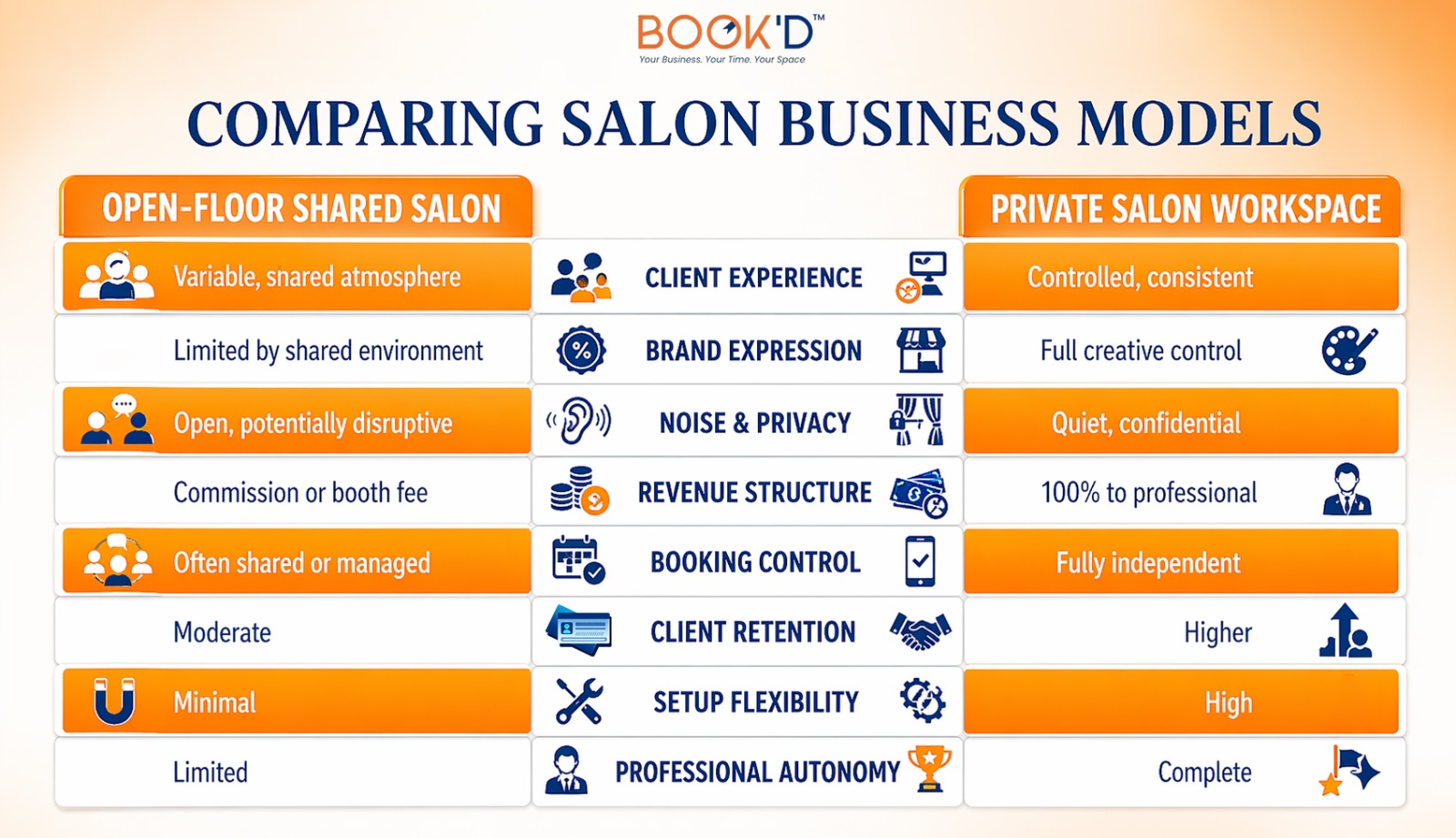
The comparison makes it pretty clear why the shift toward private workspace isn’t just about how things look or feel. It’s a strategic choice with real, measurable implications for business performance, client relationships, and how satisfied you feel in your work.
FAQs
Why are beauty professionals choosing private salon workspaces over traditional salons?
Beauty professionals are choosing private salon workspaces mainly for the control they give over the client experience, brand expression, and business operations. In a private space, you manage every part of the appointment environment, keep all the revenue from your bookings, and operate as a truly independent business instead of as a renter inside someone else’s brand. As clients increasingly expect personalised, private service experiences, private workspaces have become a competitive necessity rather than just a nice-to-have.
What are the benefits of a private salon suite for independent beauty professionals?
The benefits of a private salon suite include full control over the client environment, keeping all your revenue, operational independence, brand alignment, and higher client satisfaction and retention. Private suites also give you a more professional setting for services that involve close physical contact and personal conversation, which covers most beauty and wellness treatments. You get these advantages without the full financial commitment of leasing and building out a traditional salon.
How do private salon spaces affect client retention?
Private salon spaces improve client retention by creating a more comfortable, personalised, and consistent appointment experience. Clients who feel at ease in a private, well-controlled environment are more likely to rebook, leave good reviews, and refer other clients. The lack of background noise, the ability to have private conversations, and the visual consistency of a branded environment all feed into the emotional satisfaction that drives loyalty.
Are private salon suites more expensive than booth rentals in shared salons?
Private salon suites usually cost more per week than booth rentals in shared salons, but the comparison isn’t simple. Private suites give you full revenue retention with no commission taken out, complete brand control, and a significantly higher-quality client experience that supports premium pricing. Many professionals find that the combination of higher service prices, better client retention, and stronger referrals more than makes up for the higher rent. The net financial picture is often similar or better.
What should I look for in a private salon workspace?
When looking at a private salon workspace, focus on whether the infrastructure fits your specific services, whether there’s enough privacy, good lighting, reliable booking and access systems, and a location that works for your client base. Check what’s included in the rental rate and what the terms are for scheduling, cancellation, and any changes to the space. Visit in person before committing, and evaluate the space from your client’s perspective as well as your own working perspective.