


Opening a salon looks different on the inside than on the outside. From the outside, it’s a business with your name on it, a team you’ve built, and a space that reflects your vision. From the inside, especially in the first year or two, it’s a relentless sequence of expenses that nobody put in the brochure.
This isn’t meant to discourage anyone from building something real in the beauty industry. But the gap between what people expect salon ownership to cost and what it actually costs is wide enough to sink businesses that could have thrived with a clearer picture going in.
So this blog is going to give you that picture. Not the optimistic version. The honest one.
What Nobody Tells You Before You Sign the Lease
The Upfront Numbers Are Just the Beginning
Most conversations about salon ownership costs start with rent and buildout, and those numbers alone are sobering. Depending on your market, a commercial lease for salon space can run anywhere from $2,500 to $10,000 per month or more in major cities.
Then comes the buildout. Plumbing for shampoo bowls. Electrical for styling stations. Flooring, lighting, cabinetry, and reception furniture. A modest buildout in a mid-size market typically costs between $40,000 and $100,000. In larger cities, that ceiling climbs considerably higher.
But here’s what gets people. Most landlords require first and last month’s rent plus a security deposit before you even get the keys. You’re paying for a space you can’t yet use, for a business that hasn’t yet opened, out of savings you’ve been accumulating for years. And the clock on your lease starts running whether your chairs are full or empty.
Equipment Costs More Than You Think
The salon expenses breakdown doesn’t get easier once you move past the lease. Professional-grade equipment adds up fast. Styling chairs, shampoo units, dryers, color processing stations, reception desks, mirrors, and storage units. A fully equipped salon from scratch can require $15,000 to $50,000 in equipment alone, depending on size and quality.
That’s before you’ve bought a single product for retail or stocked a single supply closet.
The Ongoing Costs That Quietly Drain Profitability
Monthly Overhead: A Closer Look
This is where the cost of running a salon becomes a sustained financial pressure rather than a one-time investment. Monthly overhead for a traditional salon typically includes:
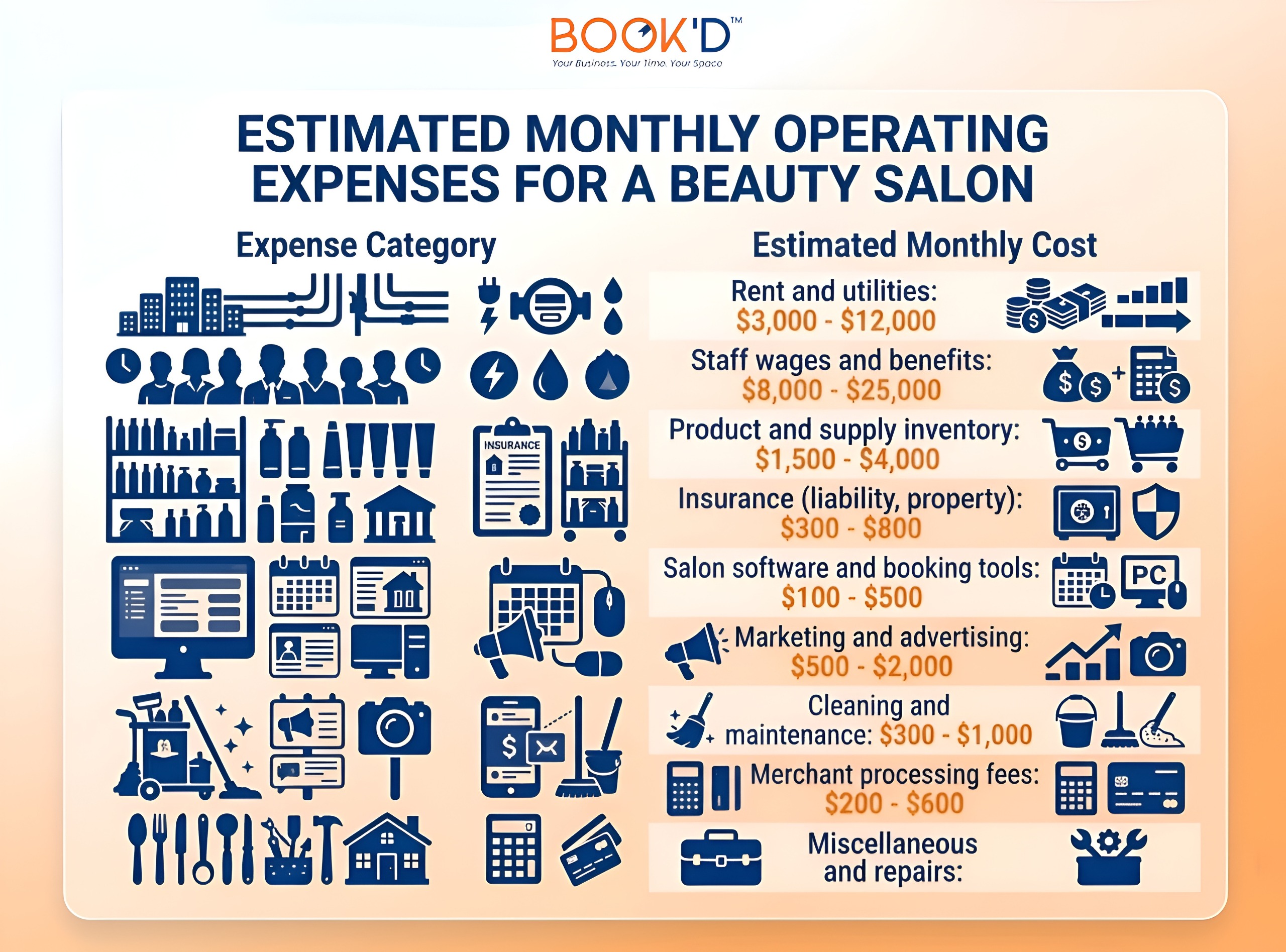
Add all that up, and you’re looking at somewhere between $14,000 and $46,000 per month before you’ve paid yourself anything. And those are conservative estimates in many markets.
Staffing Is the Wildcard
Labor is typically the largest single line item in any service business, and salons are no exception. Beyond base wages, there’s payroll tax, workers’ compensation, potential benefits, and the administrative cost of just managing a team.
High turnover, which is common in the beauty industry, adds recruiting and training costs on top of everything else. You post the job, you interview, you train, you wait for them to build a book. All of that costs time and money.
Then there’s the productivity gap. A new hire rarely generates full revenue from day one. You’re paying for their time while their client list builds, which means you’re subsidizing their transition period out of your own margin. Multiply that across even two or three staff members rotating over the course of a year, and the impact on salon financial planning becomes significant.
The Costs You Can’t Put on a Spreadsheet
Time, Energy, and Opportunity Cost
Salon ownership costs aren’t only financial. The time investment required to manage a physical location, a staff, a supply chain, a compliance calendar, and a customer experience all at once is substantial.
Many salon owners find themselves doing less of the actual service work they love and more administrative and operational work than they anticipated. Answering emails, chasing invoices, ordering supplies, fixing the sink, and covering shifts when someone calls out.
That shift has a real cost, even if it doesn’t show up on a profit-and-loss statement. It affects job satisfaction, creative energy, and the quality of attention you can bring to clients. It’s worth naming honestly before you’re already inside it.
Regulatory and Compliance Expenses
Depending on your state and city, operating a salon involves health and safety inspections, cosmetology board compliance, business licensing, signage permits, and sometimes zoning approvals. These aren’t necessarily expensive individually, but they take time and attention.
Sometimes you need legal or consulting support to navigate it correctly. Non-compliance isn’t just a fine risk. In some cases, it’s a license risk. Building that compliance infrastructure early is important, and it isn’t free.
When the Alternative Makes More Sense
This is a good point to step back and ask a question that doesn’t get asked often enough: Does your business goal actually require owning a salon? Or does it just require serving clients well in a professional environment?
For a lot of beauty professionals, the honest answer is the latter. And if that’s the case, there are paths to a thriving beauty business that don’t involve the overhead structure described above.
There’s a companion piece worth reading if you’re in the early stages of starting a beauty business on a low cost. It covers exactly how beauty professionals are building real client bases without taking on full salon ownership.
The rental model, whether through salon booth rental arrangements, gives you professional infrastructure without the lease commitment, the buildout cost, or the staffing overhead.
The numbers tell the story clearly. A stylist renting a booth or suite might pay $400 to $1,500 per week for their space. Compare that to the monthly overhead of a traditional salon, and the math becomes hard to ignore, especially in the early stages when your book is still building.
What Salon Financial Planning Actually Needs to Account For
Build the Real Numbers Before You Commit
Solid salon financial planning starts with a break-even analysis that uses realistic numbers, not optimistic ones. How many service hours per week does the salon need to generate to cover monthly overhead? How long will it realistically take to fill those hours consistently? What’s the plan for the gap between opening and break-even?
Most financial advisors suggest having six to twelve months of operating expenses in reserve before opening a brick-and-mortar business. For salons, given the buildout costs and ramp-up timeline, being closer to that twelve-month figure is genuinely smart.
The Case for Starting Smaller and Scaling Intentionally
The beauty professionals who tend to fare best financially are often the ones who resisted the pressure to go big immediately. They started by renting a salon space for rent on a flexible basis, built their clientele, proved their revenue model, and then made expansion decisions from a position of financial stability rather than financial pressure.
That path also gives you something invaluable: data. You learn your busiest days, your most profitable services, and your actual client retention rate before you’ve committed to the overhead of a full operation. That information makes every subsequent decision better.
The costs of traditional salon ownership are real, layered, and ongoing. Understanding them fully isn’t pessimism. It’s the foundation of a plan that actually works.
FAQs
What are the highest hidden costs of owning a salon?
The highest hidden costs of salon ownership are typically staffing-related expenses like turnover and training, ongoing maintenance and equipment repair, merchant processing fees, and the revenue gap during slow periods when overhead keeps running regardless of income. Many salon owners also underestimate the cost of regulatory compliance and how much time operations actually take.
How much does it cost to run a salon per month?
Monthly operating costs for a traditional salon typically range from $14,000 to $46,000, depending on location, size, and staffing. Rent and labor are usually the biggest categories. Smaller single-operator setups with booth or suite rental arrangements can operate at a fraction of that cost, which is why the rental model has grown so much in popularity.
Is owning a salon profitable?
Salon ownership can be profitable, but the margin is often narrower than people expect, especially in the early years. Profitability depends heavily on consistent client volume, smart cost management, and good pricing. Many salon owners find that profitability improves significantly once they’ve been operating long enough to build a stable, returning client base and have paid down initial startup debt.
What is salon booth rental, and how does it work?
Salon booth rental is an arrangement where an independent beauty professional rents a designated station within an existing salon, typically weekly, rather than being employed by the salon owner. The renter keeps their own revenue and manages their own clients, paying only for the space they use. It’s one of the most popular salon startup alternatives because it dramatically reduces overhead and financial risk.
How should I plan finances before opening a salon?
Before opening a salon, create a detailed break-even analysis using realistic revenue projections and full overhead costs. Have at least six to twelve months of operating expenses in reserve. Factor in buildout, equipment, licensing, insurance, and the ramp-up period before your chair utilization reaches a sustainable level. Getting input from a small business accountant who knows the beauty industry is worth the investment before you commit to a lease.