


You know the feeling. You are finally in a groove, actually making real progress on something that matters, and then your phone buzzes. Someone wants to book an appointment. You respond when you get a chance. They ask about a different day. You check the calendar, come back with options, they go quiet for a bit, then come back with another question. Twenty minutes later, a single thirty-minute slot is confirmed, and whatever focus you had is completely gone.
Now multiply that across every booking that comes in during a week. Add the rescheduling calls that always seem to arrive at the worst possible moment. The confirmation emails are sitting in the queue. The double booking happened because two calendars were not talking to each other. The cancellation nobody found out about until the gap was already there, losing money quietly in the background.
None of this is the actual work. It is just the layer of friction sitting between you and the actual work. And the uncomfortable truth is that most businesses have accepted this as just how things are rather than as a problem with a genuinely simple solution.
Online appointment scheduling is that solution. And the businesses that adopt it almost always land on the same thought afterwards. Why did we wait this long?
What Online Appointment Scheduling Actually Is
Most people hear online appointment scheduling and picture a basic booking widget sitting somewhere on a contact page. Which is a bit like describing a brilliant personal assistant as someone who answers the phone. It is not wrong exactly. It just misses everything that actually makes it valuable.
Automated appointment scheduling takes ownership of the entire booking process from the moment a client decides they want an appointment to the moment they walk through the door. The client finds the booking page, sees live availability, picks a time that works for them, gets an instant confirmation, and receives automatic reminders as the date approaches. Not a single back-and-forth message required from anyone on the business side.
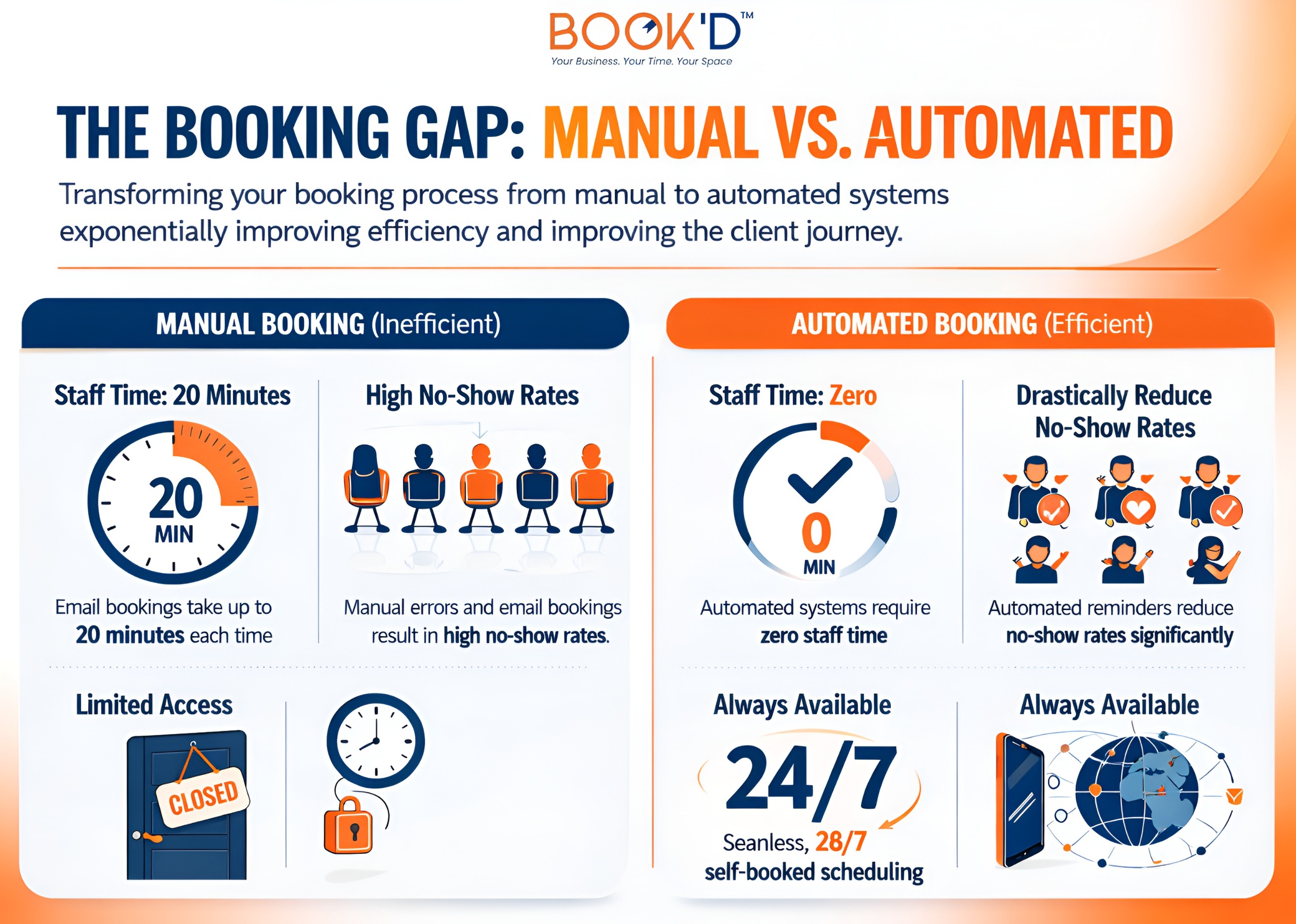
The slot gets filled. The client feels looked after. And the staff member who used to spend twenty minutes per booking managing that process has twenty minutes back to do something that actually requires a human being to do it.
The Real Cost of Sticking With Manual
The reason most businesses have not already made this switch is genuinely simple. Manual booking does not feel like a crisis. It feels like Tuesday. The interruptions are dispersed across the day in small enough doses that they register as background noise rather than a measurable drain worth addressing.
But the cost is real. Confirmation emails that need writing. Scheduling calls that break up focused work. Double bookings from calendars that were not properly synced. Clients who genuinely meant to book but lost the thread somewhere in the back-and-forth and never came back.
An online booking system solves every one of these problems simultaneously in a way that simply cannot be replicated through better organisation of a manual process. The issue was never the people doing the scheduling. The issue is that manual scheduling is a fundamentally inefficient process, regardless of how competently it gets managed.
How It Actually Gives You Time Back
Here is the thing about the time that manual scheduling costs. It never shows up as one obvious block that someone decides to address. It shows up as a constant low-level interruption that gets absorbed into the working day as though it were just part of how things work.
A few minutes to respond to a booking inquiry. A few more to confirm the details. A call to handle a rescheduling request. Time spent manually sending appointment reminders. Time spent following up with no-shows.
Scheduling software for businesses eliminates most of this overhead in one move rather than chipping away at it piece by piece. Bookings happen without staff involvement. Confirmations go out instantly. Reminders fire automatically. Cancellations open slots back up in real time rather than leaving invisible gaps that cost money nobody traces back to the booking process.
Those hours do not disappear. They go to work that actually requires a human being to show up for it.
The No-Show Problem Has a Simple Fix
A missed appointment hurts in a specific way. The slot was held. The time was blocked. Nothing was delivered, and nothing was recovered. And the reason most no-shows happen is rarely that the client does not care. It is that nothing kept the appointment concrete enough in their mind between booking and showing up.
Digital appointment scheduling builds the fix for this directly into the booking process. Automated reminder sequences that go out via text and email in the days and hours before the appointment.
Not as an add-on that someone has to remember to set up. As a standard part of how every booking works. Businesses that switch to automated reminders consistently report meaningful reductions in noshow rates compared to whatever they were doing before, and the revenue impact of that reduction alone often justifies the entire switch.
The Things People Do Not Expect Until They Switch
This one surprises people more than it probably should. Online appointment scheduling works around the clock. A client who decides they want to book at nine on a Sunday evening completes that booking immediately.
They do not have to hold the intention until Monday morning, which a meaningful number of them would not manage to do. They do not have to navigate a back-and-forth that might stretch to midweek before anything gets confirmed. They pick a time, they get confirmed, they show up.
Every after-hours booking that automated appointment scheduling captures is genuinely one that manual systems had a real chance of losing. Not because the client was not interested. Because the gap between wanting to book and actually completing a booking under a manual system is wide enough for a lot of people to fall through.
It Grows With You Without Growing the Admin
This is one of the most practically important things about digital appointment scheduling for any business thinking about growth. Under a manual system, growing the client base means growing the administrative overhead at roughly the same rate.
More bookings mean more emails, more calls, more calendar management, and more staff time absorbed by the scheduling function rather than the service being delivered. Scheduling software for businesses does not work that way. The process of handling a hundred bookings a week is the same process as handling ten.
The volume scales. The overhead does not. That operational headroom is genuinely one of the most valuable things online appointment scheduling creates for a growing business, and it is the part most people only fully appreciate after they have experienced the alternative for long enough.
FAQs
What is online appointment scheduling, and how does it actually work?
Clients book directly through a business’s website or booking page without any back-and-forth required. Real-time availability is displayed, confirmations go out automatically, reminders fire before each appointment, and cancellations get handled without staff manually involved at every step. The whole process runs continuously without consuming staff time, the way manual booking, which always ends up doing.
How does automated scheduling actually reduce no-shows?
Through reminder sequences sent via text and email in the days and hours before each appointment. These keep the booking present in the client’s awareness rather than letting it fade into the background of a busy week. Businesses that switch to automated reminders consistently see meaningfully lower no-show rates than those relying on manual follow-ups or nothing at all.
What should I actually look for in scheduling software?
Real-time availability, automatic confirmations and reminders, calendar integration with tools already in use, easy rescheduling, and a mobile-friendly booking experience for clients. Scheduling software for businesses should take administrative work off the list rather than just replacing it with a different version of the same tasks.
Is digital scheduling genuinely worth it for smaller businesses?
Honestly more worth it for smaller businesses than larger ones in a lot of ways. Small teams have the least capacity to absorb ongoing manual booking overhead and the most to gain from getting those hours back. The difference tends to feel noticeable almost immediately once the scheduling function is no longer sitting on someone’s personal task list every single day.
How quickly does online appointment scheduling actually show results?
The drop in scheduling-related interruptions tends to show up within the first week. Lower no-show rates and after-hours bookings become visible within the first few weeks of consistent use. The cumulative time saving grows meaningfully as the volume the system handles without staff involvement compounds over time.